Spotlight: Roderick Bertoncini @ Mente360
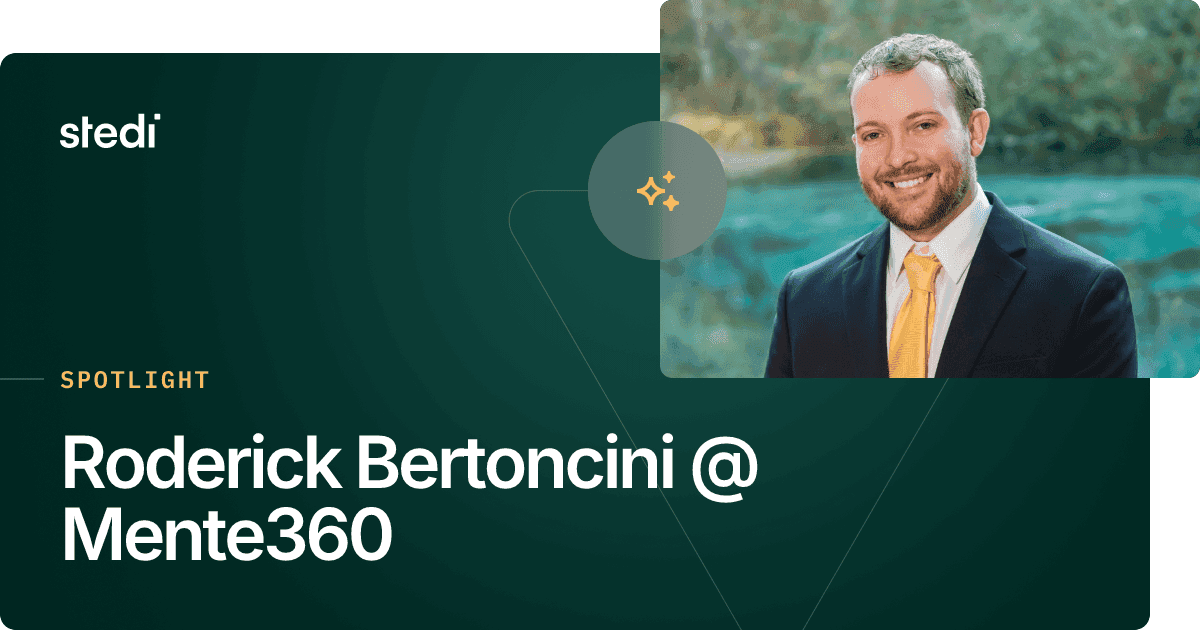
A spotlight is a short-form interview with a leader in health tech. In this spotlight, you'll hear from Roderick Bertoncini, founder of Mente360.
What does Mente360 do?
Mente360 is a practice-management platform for group mental health practices. It runs the operational spine of a clinic in one HIPAA-compliant system: scheduling, telehealth visits, clinical documentation, payments, and insurance billing. The focus is groups with six or more providers, where the administrative load scales faster than the clinical work and most tools start to creak. We handle the parts clinicians dread, the eligibility checks, the claim submission, the ERA reconciliation, so a practice can run without a back office the size of its clinical staff.
How did you end up working in health tech?
The path was not direct, but the thread goes back further than people expect. One of my first jobs was at Easter Seals UCP in Virginia and North Carolina. I was on the technology side, but I worked alongside frontline clinical staff every day, and I saw how much their tools either carried them or got in their way. That stayed with me and merged with the customer-obsessed perspective I picked up during my years at Amazon.
The other half is personal. My mother was a physician, and I watched her practice struggle after HIPAA, both with compliance and with the first generation of EMR software that small practices were suddenly expected to run. I saw those early tools up close through her. They were not good. And the part that still surprises me is how little they have improved since. The incumbents stopped listening to clinicians a long time ago, and it shows in the software.
So when I built Mente360, the non-negotiable was that a clinician shaped it from the start. My wife is a licensed clinical psychologist, and she's been active in shaping the product, not consulted once at the end. Every workflow gets tested against one question: does this actually help the person doing the clinical work or the back office work? That is what people feel when they use it, and it is the part the big platforms cannot fake.
I spent two decades running cloud infrastructure at scale, and the discipline there is the same one health tech has been missing: systems should be automated, observable, and boring when they work.
AI moved the line of what was possible. The development process and the automation potential are different than they were even two years ago. But automation only pays off if the structure underneath it is sound, and in revenue cycle that means strong partners. Stedi is one of ours. A modern, API-first clearinghouse is what lets a small practice run a clean revenue cycle. Great technology is what helps these practices grow and keep pace with the bigger players.
How does your role intersect with revenue cycle management (RCM)?
Completely. I am the founder, but I also wrote the claims pipeline, so RCM is not a department I manage. It is code I wrote.
In a small practice the revenue cycle is usually one person with a spreadsheet and a lot of patience. My job is to envision a better way for that to work. We are building a platform that takes the parts of patient intake, eligibility, and claims submission that are tedious but high-stakes, and automates them. That is harder than it sounds. Doing it well takes two things: smartly built APIs, and real insight into how a practice actually runs day to day. You cannot automate a workflow you do not understand, and most billing software was clearly built by people who never sat at the front desk.
The second half of my job is making that real, and that is where a partner like Stedi comes in. Building on the Stedi API lets us stay focused on the customers we know well, instead of getting buried in the nuances of thousands of different payers. That is what makes the rest possible. We are building automation around the billing cycle and a layer of intelligence around claims that smaller practices have never had access to. We want to tell a practice exactly why a claim was rejected and what to do about it, automate the fix everywhere we can, and then go a step further: predictive flagging that catches claims likely to be denied before they are ever submitted. For a small practice, that is time and money they get to keep.
What do you think RCM will look like two years from now?
Two years out, the boring parts will run themselves. Eligibility, claim scrubbing, ERA posting, and first-pass denial handling are rules-plus-pattern problems, and that is exactly what agents are good at now. The work left for humans shifts from running the cycle to supervising the exceptions.
The thing I am skeptical about is the pitch that AI can just make denials disappear. This is regulated money movement, and in some ways an arms race. Payers will always deny the claims they can justifiably deny. The trick is to remove as many of those justifications as possible before the claim ever goes out. So the platforms that win will not be the ones with the most automation. They will be the ones whose automation is verifiable: it can produce the right justification or proof on demand, and a human can see exactly what the system did and why.
That, and a future where someone like my wife does not spend eight hours with clients and then another three sorting out why she has not been paid. If it is not obvious on the screen why a claim failed, I want her to be able to ask in plain language and get a plain answer. "Why did the claim for Mr. Johnson fail?" "It was not pre-authorized." That level of clarity, in a process that today feels opaque to most clinicians. That is what I am building toward.