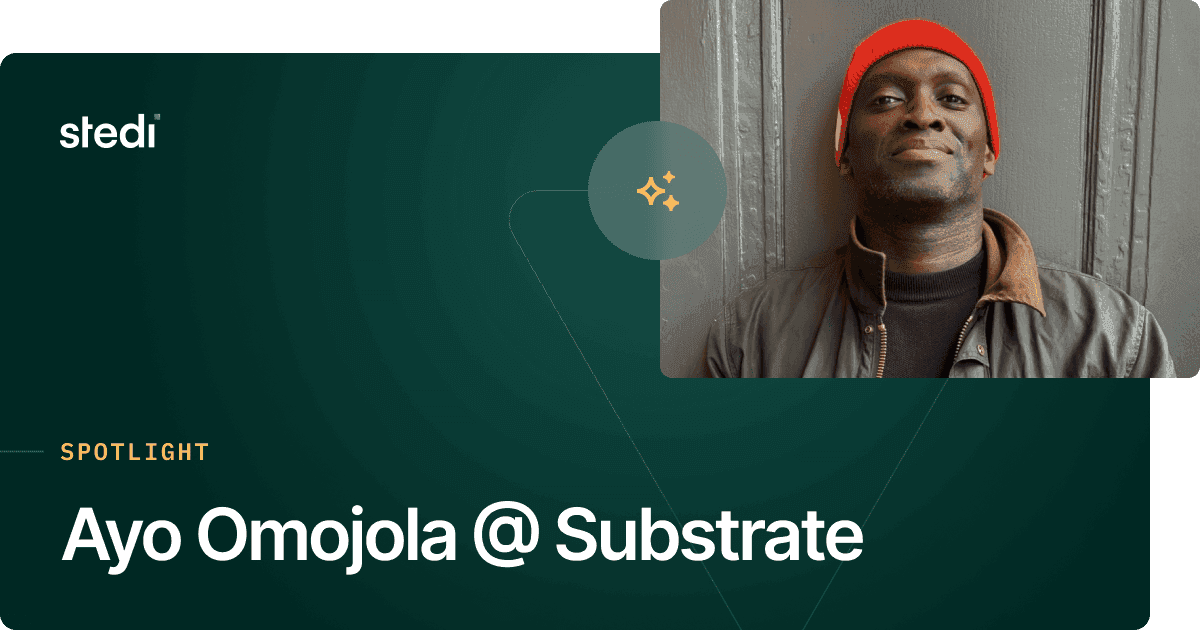
Spotlight: Ayo Omojola @ Substrate
Spotlight

Spotlight: Ayo Omojola @ Substrate

A spotlight is a short-form interview with a leader in health tech. In this spotlight, you'll hear from Ayo Omojola, founder and CEO of Substrate AI.

What does Substrate do?

Substrate AI builds AI agents for healthcare RCM. We focus on outpatient physician groups and specialty practices: orthopedics, dermatology, cardiology, behavioral health, infusion centers – and help them automate the most painful parts of getting paid.

Our core product is a suite of automations that handle claim status, medical record appeals, payment posting, and patient credits. The claim status agent is the first touch in AR follow-up. It intelligently checks claim status across 3,000+ payers using EDI (primarily via Stedi), APIs, and browser agents, then maps results back into your PM system with the right worklist actions.

The Appeals Agent combines claim status intelligence with medical necessity evaluation to autonomously submit appeals with the right documentation. And our payment posting agent handles posting ERAs that most rules-based automations struggle with.

We’re AI-native and compatible with over two dozen EMR/PM systems. Practices just give us a login, with no IT implementation required. In many cases, clients see results in under 24 hours, and experience 70-80% savings on average after deploying Substrate, primarily in the form of headcount savings.

If you run a large RCM team (over 100 people), we can probably help you save money and collect faster.

How did you end up working in health tech?

My path to healthcare wasn’t linear. I started my career trading bonds and FX at Bank of America, then went through Y Combinator in 2012 with Hipmob, a mobile customer support platform. After that, I ran product teams at Cash App and Carbon Health, which is where I really got immersed in the operational side of healthcare.

At Carbon Health during the pandemic, I saw firsthand how broken the revenue cycle is for provider organizations. Brilliant clinicians were running great practices, but hemorrhaging money because of claim denials, slow follow-up, and manual processes that hadn’t fundamentally changed in decades. The billing teams were working incredibly hard, but they were fighting payer complexity with spreadsheets and phone calls.

When I saw what was becoming possible with large language models, the opportunity clicked. RCM is a massive, messy information-processing problem spread across thousands of payers with different rules, portals, and formats. That’s exactly the kind of problem AI agents are built to solve.

How does your role intersect with revenue cycle management (RCM)?

RCM is the entire business. As founder, I’m deeply embedded in every layer of it, from the technical architecture of how we process claims across 3,500+ payers, to sitting with billing teams at our client practices to understand exactly where their workflows break down.

Every single workflow we’ve automated is one I’ve done manually personally hundreds or thousands of times; I’ve personally done AR follow-up, posted payments, and appealed claims by hand – and I still do all those things today as part of our product development process.

My job is to make sure everything we ship actually works in production, against real payer complexity, at a higher standard than practices would expect from their own team.

What do you think RCM will look like two years from now?

I believe if you want to understand how something works in healthcare, start with the assumption that payers don’t want to pay providers, and work backwards from there. Payers are perfectly happy for a doctor to care for their member, and not get paid. It happens all the time. This is a function of incentives, not malice.

Billers fight so doctors can get paid. Software and agents can now do this. I know this because Substrate clients are seeing up to 75% savings in production, with higher consistency than they had before. Today, this is rare. In two years, it will be widespread.

Spotlight: Ayo Omojola @ Substrate

A spotlight is a short-form interview with a leader in health tech. In this spotlight, you'll hear from Ayo Omojola, founder and CEO of Substrate AI.

What does Substrate do?

Substrate AI builds AI agents for healthcare RCM. We focus on outpatient physician groups and specialty practices: orthopedics, dermatology, cardiology, behavioral health, infusion centers – and help them automate the most painful parts of getting paid.

Our core product is a suite of automations that handle claim status, medical record appeals, payment posting, and patient credits. The claim status agent is the first touch in AR follow-up. It intelligently checks claim status across 3,000+ payers using EDI (primarily via Stedi), APIs, and browser agents, then maps results back into your PM system with the right worklist actions.

The Appeals Agent combines claim status intelligence with medical necessity evaluation to autonomously submit appeals with the right documentation. And our payment posting agent handles posting ERAs that most rules-based automations struggle with.

We’re AI-native and compatible with over two dozen EMR/PM systems. Practices just give us a login, with no IT implementation required. In many cases, clients see results in under 24 hours, and experience 70-80% savings on average after deploying Substrate, primarily in the form of headcount savings.

If you run a large RCM team (over 100 people), we can probably help you save money and collect faster.

How did you end up working in health tech?

My path to healthcare wasn’t linear. I started my career trading bonds and FX at Bank of America, then went through Y Combinator in 2012 with Hipmob, a mobile customer support platform. After that, I ran product teams at Cash App and Carbon Health, which is where I really got immersed in the operational side of healthcare.

At Carbon Health during the pandemic, I saw firsthand how broken the revenue cycle is for provider organizations. Brilliant clinicians were running great practices, but hemorrhaging money because of claim denials, slow follow-up, and manual processes that hadn’t fundamentally changed in decades. The billing teams were working incredibly hard, but they were fighting payer complexity with spreadsheets and phone calls.

When I saw what was becoming possible with large language models, the opportunity clicked. RCM is a massive, messy information-processing problem spread across thousands of payers with different rules, portals, and formats. That’s exactly the kind of problem AI agents are built to solve.

How does your role intersect with revenue cycle management (RCM)?

RCM is the entire business. As founder, I’m deeply embedded in every layer of it, from the technical architecture of how we process claims across 3,500+ payers, to sitting with billing teams at our client practices to understand exactly where their workflows break down.

Every single workflow we’ve automated is one I’ve done manually personally hundreds or thousands of times; I’ve personally done AR follow-up, posted payments, and appealed claims by hand – and I still do all those things today as part of our product development process.

My job is to make sure everything we ship actually works in production, against real payer complexity, at a higher standard than practices would expect from their own team.

What do you think RCM will look like two years from now?

I believe if you want to understand how something works in healthcare, start with the assumption that payers don’t want to pay providers, and work backwards from there. Payers are perfectly happy for a doctor to care for their member, and not get paid. It happens all the time. This is a function of incentives, not malice.

Billers fight so doctors can get paid. Software and agents can now do this. I know this because Substrate clients are seeing up to 75% savings in production, with higher consistency than they had before. Today, this is rare. In two years, it will be widespread.

Share

Twitter
LinkedIn

Get started with Stedi

Get started with Stedi

Automate healthcare transactions with developer-friendly APIs that support thousands of payers. Contact us to learn more and speak to the team.

Get updates on what’s new at Stedi

Get updates on what’s new at Stedi

Get updates on what’s new at Stedi

Get updates on what’s new at Stedi

Backed by

Stedi and the S design mark are registered trademarks of Stedi, Inc. All names, logos, and brands of third parties listed on our site are trademarks of their respective owners (including “X12”, which is a trademark of X12 Incorporated). Stedi, Inc. and its products and services are not endorsed by, sponsored by, or affiliated with these third parties. Our use of these names, logos, and brands is for identification purposes only, and does not imply any such endorsement, sponsorship, or affiliation.

Get updates on what’s new at Stedi

Backed by

Stedi and the S design mark are registered trademarks of Stedi, Inc. All names, logos, and brands of third parties listed on our site are trademarks of their respective owners (including “X12”, which is a trademark of X12 Incorporated). Stedi, Inc. and its products and services are not endorsed by, sponsored by, or affiliated with these third parties. Our use of these names, logos, and brands is for identification purposes only, and does not imply any such endorsement, sponsorship, or affiliation.

Get updates on what’s new at Stedi

Backed by

Stedi and the S design mark are registered trademarks of Stedi, Inc. All names, logos, and brands of third parties listed on our site are trademarks of their respective owners (including “X12”, which is a trademark of X12 Incorporated). Stedi, Inc. and its products and services are not endorsed by, sponsored by, or affiliated with these third parties. Our use of these names, logos, and brands is for identification purposes only, and does not imply any such endorsement, sponsorship, or affiliation.