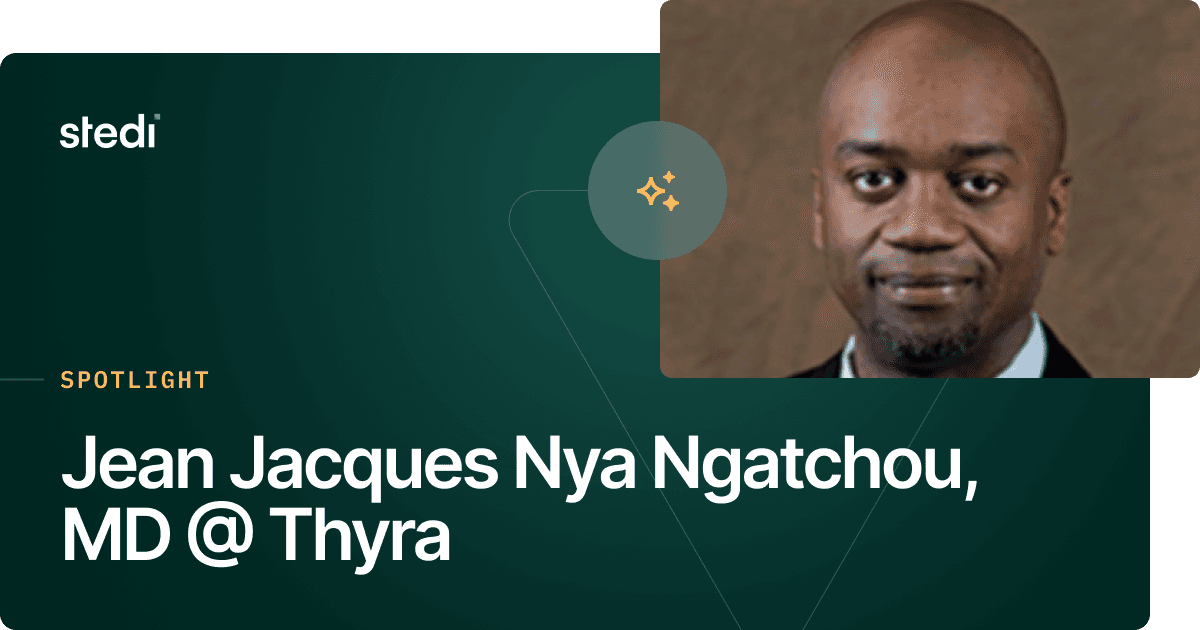
Spotlight: Jean Jacques Nya Ngatchou, MD @ Thyra
Jan 14, 2026
Spotlight

A spotlight is a short-form interview with a leader in health tech. In this spotlight, you'll hear from Jean Jacques Nya Ngatchou, MD, founder of Thyra.
What does Thyra do?
Thyra is an AI-native EHR. Built one specialty at a time. Starting with endocrinology and primary care.
One Clinical Brain runs two surfaces. Clinician workflow and billing. It turns longitudinal patient context into actions. Notes, orders, inbox triage, prior auth, billing-ready outputs.
Here’s the sharp edge. CGM data is already telling you what to do. Most clinics still treat it like noise because the review and documentation workflow is broken. That’s tens of thousands per provider per year in missed reimbursement and wasted effort.
Thyra reads CGM like an instrument. Pattern recognition. Structured interpretation. Documentation generated. CPT 95251 supported by default. Physician reviews and signs. The point is not nicer documentation. The point is fewer clicks, safer care, and revenue that stops leaking.
How did you end up working in health tech?
I’m a practicing endocrinologist. I live inside EHRs every day.
At some point it became obvious. The problem isn’t training. It’s tool design. Most systems store data. They don’t think longitudinally. They don’t execute. So I started building the system I wanted as a clinician. A Clinical Brain that actually runs the work.
How does your role intersect with revenue cycle management (RCM)?
I sit where clinical intent becomes revenue. And where workflows leak. In endocrinology, care is continuous. Device data streams in daily. Time-based services compound. Small misses become large losses.
Thyra treats revenue capture as part of care delivery. Not a downstream cleanup job. We interpret CGM patterns, generate the structured documentation, and make billing support automatic. Good care creates billing-ready output by default.
What do you think RCM will look like two years from now?
More preventive. Less reactive. The best RCM won’t live in the back office. It will live upstream, inside the clinician workflow.
Eligibility in real time. Prior auth as a guided pathway. Claims assembled from structured signals, not chart chasing. Device data is the proof case. Today, CGM generates 288 readings per day per patient. Most practices still can’t turn that into clean, billable documentation at scale. Two years from now, that will look absurd.
The EHR will interpret the data, generate the note, and support the code. The physician reviews and approves. AI won’t replace billing teams. It will kill rework. Reduce denials. Make compliance auditable without extra effort.
The future EHR is a clinical brain with operational surfaces. Thyra is that shift.

A spotlight is a short-form interview with a leader in health tech. In this spotlight, you'll hear from Jean Jacques Nya Ngatchou, MD, founder of Thyra.
What does Thyra do?
Thyra is an AI-native EHR. Built one specialty at a time. Starting with endocrinology and primary care.
One Clinical Brain runs two surfaces. Clinician workflow and billing. It turns longitudinal patient context into actions. Notes, orders, inbox triage, prior auth, billing-ready outputs.
Here’s the sharp edge. CGM data is already telling you what to do. Most clinics still treat it like noise because the review and documentation workflow is broken. That’s tens of thousands per provider per year in missed reimbursement and wasted effort.
Thyra reads CGM like an instrument. Pattern recognition. Structured interpretation. Documentation generated. CPT 95251 supported by default. Physician reviews and signs. The point is not nicer documentation. The point is fewer clicks, safer care, and revenue that stops leaking.
How did you end up working in health tech?
I’m a practicing endocrinologist. I live inside EHRs every day.
At some point it became obvious. The problem isn’t training. It’s tool design. Most systems store data. They don’t think longitudinally. They don’t execute. So I started building the system I wanted as a clinician. A Clinical Brain that actually runs the work.
How does your role intersect with revenue cycle management (RCM)?
I sit where clinical intent becomes revenue. And where workflows leak. In endocrinology, care is continuous. Device data streams in daily. Time-based services compound. Small misses become large losses.
Thyra treats revenue capture as part of care delivery. Not a downstream cleanup job. We interpret CGM patterns, generate the structured documentation, and make billing support automatic. Good care creates billing-ready output by default.
What do you think RCM will look like two years from now?
More preventive. Less reactive. The best RCM won’t live in the back office. It will live upstream, inside the clinician workflow.
Eligibility in real time. Prior auth as a guided pathway. Claims assembled from structured signals, not chart chasing. Device data is the proof case. Today, CGM generates 288 readings per day per patient. Most practices still can’t turn that into clean, billable documentation at scale. Two years from now, that will look absurd.
The EHR will interpret the data, generate the note, and support the code. The physician reviews and approves. AI won’t replace billing teams. It will kill rework. Reduce denials. Make compliance auditable without extra effort.
The future EHR is a clinical brain with operational surfaces. Thyra is that shift.

A spotlight is a short-form interview with a leader in health tech. In this spotlight, you'll hear from Jean Jacques Nya Ngatchou, MD, founder of Thyra.
What does Thyra do?
Thyra is an AI-native EHR. Built one specialty at a time. Starting with endocrinology and primary care.
One Clinical Brain runs two surfaces. Clinician workflow and billing. It turns longitudinal patient context into actions. Notes, orders, inbox triage, prior auth, billing-ready outputs.
Here’s the sharp edge. CGM data is already telling you what to do. Most clinics still treat it like noise because the review and documentation workflow is broken. That’s tens of thousands per provider per year in missed reimbursement and wasted effort.
Thyra reads CGM like an instrument. Pattern recognition. Structured interpretation. Documentation generated. CPT 95251 supported by default. Physician reviews and signs. The point is not nicer documentation. The point is fewer clicks, safer care, and revenue that stops leaking.
How did you end up working in health tech?
I’m a practicing endocrinologist. I live inside EHRs every day.
At some point it became obvious. The problem isn’t training. It’s tool design. Most systems store data. They don’t think longitudinally. They don’t execute. So I started building the system I wanted as a clinician. A Clinical Brain that actually runs the work.
How does your role intersect with revenue cycle management (RCM)?
I sit where clinical intent becomes revenue. And where workflows leak. In endocrinology, care is continuous. Device data streams in daily. Time-based services compound. Small misses become large losses.
Thyra treats revenue capture as part of care delivery. Not a downstream cleanup job. We interpret CGM patterns, generate the structured documentation, and make billing support automatic. Good care creates billing-ready output by default.
What do you think RCM will look like two years from now?
More preventive. Less reactive. The best RCM won’t live in the back office. It will live upstream, inside the clinician workflow.
Eligibility in real time. Prior auth as a guided pathway. Claims assembled from structured signals, not chart chasing. Device data is the proof case. Today, CGM generates 288 readings per day per patient. Most practices still can’t turn that into clean, billable documentation at scale. Two years from now, that will look absurd.
The EHR will interpret the data, generate the note, and support the code. The physician reviews and approves. AI won’t replace billing teams. It will kill rework. Reduce denials. Make compliance auditable without extra effort.
The future EHR is a clinical brain with operational surfaces. Thyra is that shift.
Share
Get started with Stedi
Automate healthcare transactions with developer-friendly APIs that support thousands of payers. Contact us to learn more and speak to the team.
Get updates on what’s new at Stedi
Developers
Resources
Backed by
Stedi is a registered trademark of Stedi, Inc. All names, logos, and brands of third parties listed on our site are trademarks of their respective owners (including “X12”, which is a trademark of X12 Incorporated). Stedi, Inc. and its products and services are not endorsed by, sponsored by, or affiliated with these third parties. Our use of these names, logos, and brands is for identification purposes only, and does not imply any such endorsement, sponsorship, or affiliation.
Backed by
Stedi is a registered trademark of Stedi, Inc. All names, logos, and brands of third parties listed on our site are trademarks of their respective owners (including “X12”, which is a trademark of X12 Incorporated). Stedi, Inc. and its products and services are not endorsed by, sponsored by, or affiliated with these third parties. Our use of these names, logos, and brands is for identification purposes only, and does not imply any such endorsement, sponsorship, or affiliation.
Developers
Resources
Get updates on what’s new at Stedi
Backed by
Stedi is a registered trademark of Stedi, Inc. All names, logos, and brands of third parties listed on our site are trademarks of their respective owners (including “X12”, which is a trademark of X12 Incorporated). Stedi, Inc. and its products and services are not endorsed by, sponsored by, or affiliated with these third parties. Our use of these names, logos, and brands is for identification purposes only, and does not imply any such endorsement, sponsorship, or affiliation.
