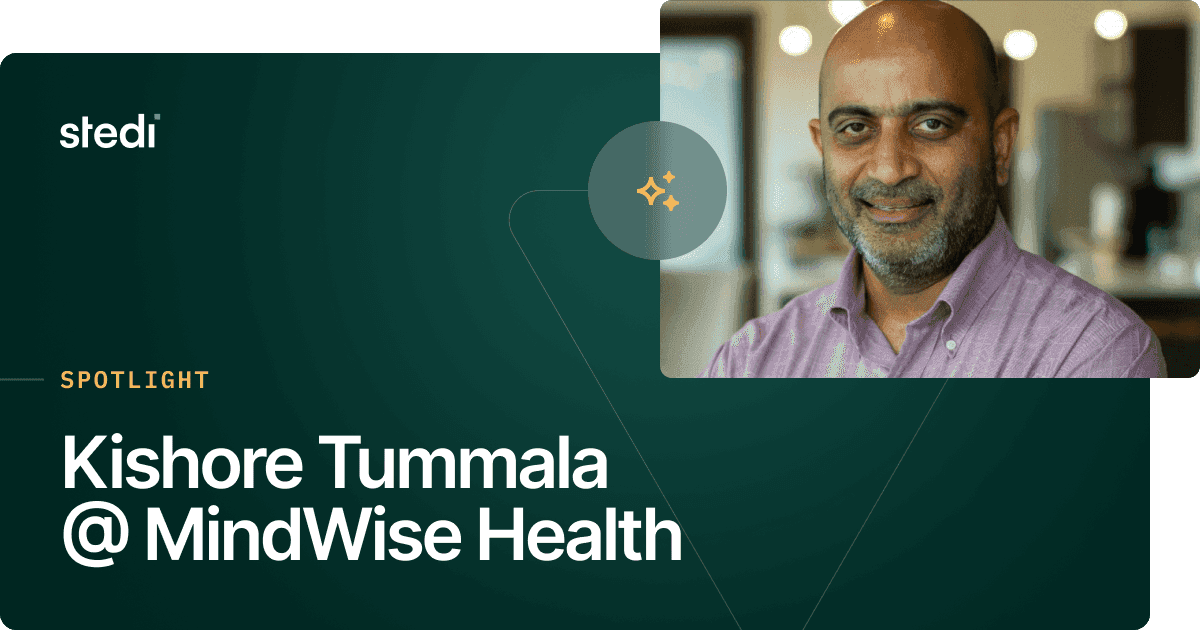
Spotlight: Kishore Tummala @ MindWise Health
Jan 22, 2026
Spotlight

A spotlight is a short-form interview with a leader in health tech. In this spotlight, you'll hear from Kishore Tummala, founder and CEO of MindWise Health.
What does MindWise Health do?
MindWise Health is an enterprise-grade EHR platform that has a primary focus on behavioral, mental, and whole health.
Mindwise Health focuses on simplifying care delivery and operations for clinics and providers. Our EHR Platform supports clinical documentation, assessments, telehealth, e-prescribing, interoperability (FHIR/C-CDA), quality reporting, and integrated workflows across the full patient journey.
Our goal is to reduce administrative burden so clinicians can focus on care, while giving organizations the data, compliance, and automation they need to scale sustainably.
How did you end up working in health tech?
I came into health tech through a combination of engineering and problem-solving. My background is in full-stack software development, and I initially worked on building complex, regulated systems in other industries.
As I worked more closely with healthcare organizations such as eviCore and Cigna, I saw how fragmented systems, manual processes, and poor data flow were directly impacting both clinicians and patients. That gap – between what technology could do and what healthcare systems were actually using – pulled me in.
MindWise Health was created to bring modern, secure, and clinician-friendly technology into healthcare, an area that has historically been underserved by good software.
How does your role intersect with revenue cycle management (RCM)?
While MindWise Health isn’t a billing company, my role intersects heavily with RCM because technology decisions upstream directly affect revenue outcomes downstream.
That includes:
Ensuring documentation supports medical necessity and audit readiness.
Structuring clinical workflows so that coding and claims data are clean and complete.
Integrating eligibility checks, quality measures, and structured data capture.
Reducing rework caused by missing or inconsistent clinical data.
In short, better clinical systems lead to fewer denials, faster reimbursements, and more predictable revenue – so RCM considerations are baked into our platform design from day one.
What do you think RCM will look like two years from now?
RCM will be far more automated, data-driven, and proactive than it is today.
Over the next two years, I expect:
AI-assisted coding and documentation validation to become standard.
Real-time eligibility and authorization checks will be embedded directly into the majority of clinical workflows.
Earlier detection of denial risk, before claims are even submitted.
Closer alignment between clinical quality data and reimbursement, especially as value-based care expands.
The organizations that succeed will be the ones that treat RCM not as a back-office function, but as an integrated extension of clinical operations – and that’s where technology platforms like ours play a critical role.

A spotlight is a short-form interview with a leader in health tech. In this spotlight, you'll hear from Kishore Tummala, founder and CEO of MindWise Health.
What does MindWise Health do?
MindWise Health is an enterprise-grade EHR platform that has a primary focus on behavioral, mental, and whole health.
Mindwise Health focuses on simplifying care delivery and operations for clinics and providers. Our EHR Platform supports clinical documentation, assessments, telehealth, e-prescribing, interoperability (FHIR/C-CDA), quality reporting, and integrated workflows across the full patient journey.
Our goal is to reduce administrative burden so clinicians can focus on care, while giving organizations the data, compliance, and automation they need to scale sustainably.
How did you end up working in health tech?
I came into health tech through a combination of engineering and problem-solving. My background is in full-stack software development, and I initially worked on building complex, regulated systems in other industries.
As I worked more closely with healthcare organizations such as eviCore and Cigna, I saw how fragmented systems, manual processes, and poor data flow were directly impacting both clinicians and patients. That gap – between what technology could do and what healthcare systems were actually using – pulled me in.
MindWise Health was created to bring modern, secure, and clinician-friendly technology into healthcare, an area that has historically been underserved by good software.
How does your role intersect with revenue cycle management (RCM)?
While MindWise Health isn’t a billing company, my role intersects heavily with RCM because technology decisions upstream directly affect revenue outcomes downstream.
That includes:
Ensuring documentation supports medical necessity and audit readiness.
Structuring clinical workflows so that coding and claims data are clean and complete.
Integrating eligibility checks, quality measures, and structured data capture.
Reducing rework caused by missing or inconsistent clinical data.
In short, better clinical systems lead to fewer denials, faster reimbursements, and more predictable revenue – so RCM considerations are baked into our platform design from day one.
What do you think RCM will look like two years from now?
RCM will be far more automated, data-driven, and proactive than it is today.
Over the next two years, I expect:
AI-assisted coding and documentation validation to become standard.
Real-time eligibility and authorization checks will be embedded directly into the majority of clinical workflows.
Earlier detection of denial risk, before claims are even submitted.
Closer alignment between clinical quality data and reimbursement, especially as value-based care expands.
The organizations that succeed will be the ones that treat RCM not as a back-office function, but as an integrated extension of clinical operations – and that’s where technology platforms like ours play a critical role.

A spotlight is a short-form interview with a leader in health tech. In this spotlight, you'll hear from Kishore Tummala, founder and CEO of MindWise Health.
What does MindWise Health do?
MindWise Health is an enterprise-grade EHR platform that has a primary focus on behavioral, mental, and whole health.
Mindwise Health focuses on simplifying care delivery and operations for clinics and providers. Our EHR Platform supports clinical documentation, assessments, telehealth, e-prescribing, interoperability (FHIR/C-CDA), quality reporting, and integrated workflows across the full patient journey.
Our goal is to reduce administrative burden so clinicians can focus on care, while giving organizations the data, compliance, and automation they need to scale sustainably.
How did you end up working in health tech?
I came into health tech through a combination of engineering and problem-solving. My background is in full-stack software development, and I initially worked on building complex, regulated systems in other industries.
As I worked more closely with healthcare organizations such as eviCore and Cigna, I saw how fragmented systems, manual processes, and poor data flow were directly impacting both clinicians and patients. That gap – between what technology could do and what healthcare systems were actually using – pulled me in.
MindWise Health was created to bring modern, secure, and clinician-friendly technology into healthcare, an area that has historically been underserved by good software.
How does your role intersect with revenue cycle management (RCM)?
While MindWise Health isn’t a billing company, my role intersects heavily with RCM because technology decisions upstream directly affect revenue outcomes downstream.
That includes:
Ensuring documentation supports medical necessity and audit readiness.
Structuring clinical workflows so that coding and claims data are clean and complete.
Integrating eligibility checks, quality measures, and structured data capture.
Reducing rework caused by missing or inconsistent clinical data.
In short, better clinical systems lead to fewer denials, faster reimbursements, and more predictable revenue – so RCM considerations are baked into our platform design from day one.
What do you think RCM will look like two years from now?
RCM will be far more automated, data-driven, and proactive than it is today.
Over the next two years, I expect:
AI-assisted coding and documentation validation to become standard.
Real-time eligibility and authorization checks will be embedded directly into the majority of clinical workflows.
Earlier detection of denial risk, before claims are even submitted.
Closer alignment between clinical quality data and reimbursement, especially as value-based care expands.
The organizations that succeed will be the ones that treat RCM not as a back-office function, but as an integrated extension of clinical operations – and that’s where technology platforms like ours play a critical role.
Share
Get started with Stedi
Automate healthcare transactions with developer-friendly APIs that support thousands of payers. Contact us to learn more and speak to the team.
Get updates on what’s new at Stedi
Developers
Resources
Backed by
Stedi is a registered trademark of Stedi, Inc. All names, logos, and brands of third parties listed on our site are trademarks of their respective owners (including “X12”, which is a trademark of X12 Incorporated). Stedi, Inc. and its products and services are not endorsed by, sponsored by, or affiliated with these third parties. Our use of these names, logos, and brands is for identification purposes only, and does not imply any such endorsement, sponsorship, or affiliation.
Developers
Resources
Backed by
Stedi is a registered trademark of Stedi, Inc. All names, logos, and brands of third parties listed on our site are trademarks of their respective owners (including “X12”, which is a trademark of X12 Incorporated). Stedi, Inc. and its products and services are not endorsed by, sponsored by, or affiliated with these third parties. Our use of these names, logos, and brands is for identification purposes only, and does not imply any such endorsement, sponsorship, or affiliation.
Developers
Resources
Get updates on what’s new at Stedi
Backed by
Stedi is a registered trademark of Stedi, Inc. All names, logos, and brands of third parties listed on our site are trademarks of their respective owners (including “X12”, which is a trademark of X12 Incorporated). Stedi, Inc. and its products and services are not endorsed by, sponsored by, or affiliated with these third parties. Our use of these names, logos, and brands is for identification purposes only, and does not imply any such endorsement, sponsorship, or affiliation.
