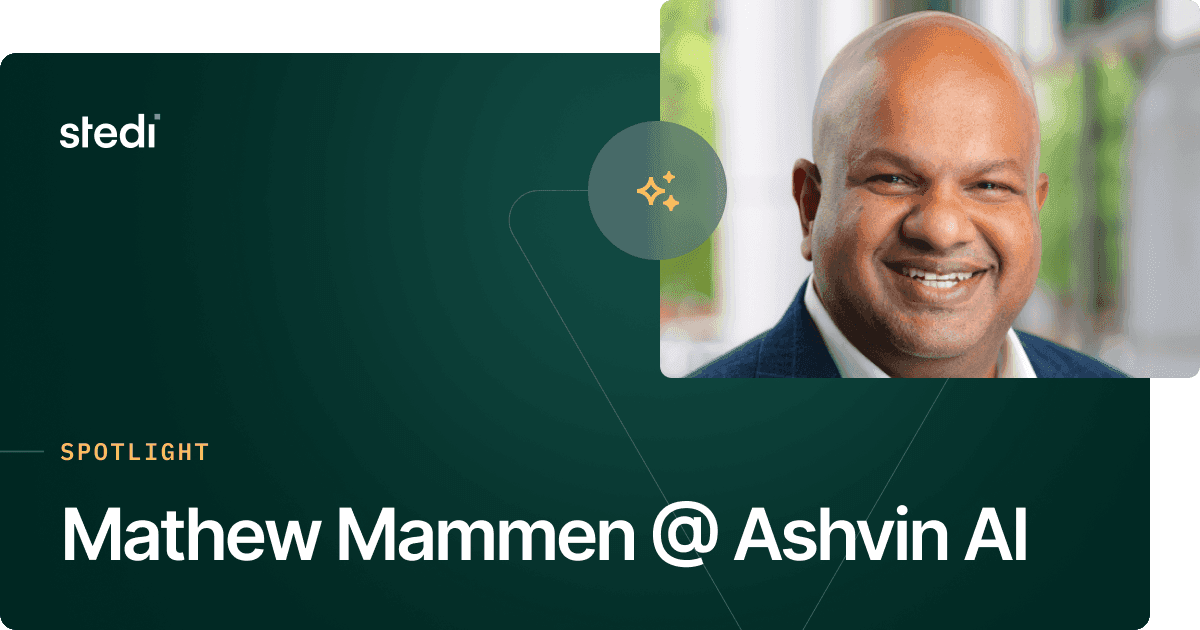
Spotlight: Mathew Mammen @ Ashvin AI
Jan 21, 2026

Spotlight

A spotlight is a short-form interview with a leader in health tech. In this spotlight, you'll hear from Mathew Mammen, co-founder and CEO of Ashvin AI.

What does Ashvin AI do?

Ashvin AI is the financial operating system for DME providers.

We help providers clear referrals in minutes, set up patients the same day, and get paid weeks faster – all while reducing denials by up to 77%. Unlike siloed tools, Ashvin is an end-to-end operating system: one source of truth, real-time decisions, and financial certainty.

How did you end up working in health tech?

I got into health tech by necessity. I originally trained as a software engineer, but I spent the last 20 years as a healthcare entrepreneur, owning and operating DME businesses and diagnostic sleep clinics. As we expanded our sleep lab operations across multiple states, it became clear that our existing data and workflow processes weren’t scalable.

So I started building software to make the operation more efficient and consistent, first to solve my own problems, and then because I realized the same challenges were widespread across the industry. That combination of hands-on operations experience and an engineering mindset is what ultimately pulled me into health tech. 

How does your role intersect with revenue cycle management (RCM)?

My role intersects with RCM in two ways: operationally and strategically.

As CEO of Ashvin, I’m building a platform that applies AI to the entire referral-to-cash lifecycle, starting at intake, where many downstream denials, rework, and cash delays are created. In other words, we’re not just helping providers “work claims” more efficiently; we’re helping them prevent revenue-cycle issues upstream by making eligibility, documentation, medical-necessity, and authorization decisions with high certainty before the order ever hits billing.

Strategically, Ashvin’s broader vision is a healthcare commerce platform that enables buyers (payers) and sellers (providers) to exchange value near real time with high certainty. As that happens, RCM evolves from a back-end function into revenue operations embedded in care delivery, where clean claims, fewer denials, faster cash, and better patient access are driven by better decisions at the point of workflow, not by downstream corrections.

So my role sits at the intersection of RCM and care operations: re-engineering the front end to make the back end largely automatic.

What do you think RCM will look like two years from now?

Near real-time, with high certainty, significantly smaller footprint.

A spotlight is a short-form interview with a leader in health tech. In this spotlight, you'll hear from Mathew Mammen, co-founder and CEO of Ashvin AI.

What does Ashvin AI do?

Ashvin AI is the financial operating system for DME providers.

We help providers clear referrals in minutes, set up patients the same day, and get paid weeks faster – all while reducing denials by up to 77%. Unlike siloed tools, Ashvin is an end-to-end operating system: one source of truth, real-time decisions, and financial certainty.

How did you end up working in health tech?

I got into health tech by necessity. I originally trained as a software engineer, but I spent the last 20 years as a healthcare entrepreneur, owning and operating DME businesses and diagnostic sleep clinics. As we expanded our sleep lab operations across multiple states, it became clear that our existing data and workflow processes weren’t scalable.

So I started building software to make the operation more efficient and consistent, first to solve my own problems, and then because I realized the same challenges were widespread across the industry. That combination of hands-on operations experience and an engineering mindset is what ultimately pulled me into health tech. 

How does your role intersect with revenue cycle management (RCM)?

My role intersects with RCM in two ways: operationally and strategically.

As CEO of Ashvin, I’m building a platform that applies AI to the entire referral-to-cash lifecycle, starting at intake, where many downstream denials, rework, and cash delays are created. In other words, we’re not just helping providers “work claims” more efficiently; we’re helping them prevent revenue-cycle issues upstream by making eligibility, documentation, medical-necessity, and authorization decisions with high certainty before the order ever hits billing.

Strategically, Ashvin’s broader vision is a healthcare commerce platform that enables buyers (payers) and sellers (providers) to exchange value near real time with high certainty. As that happens, RCM evolves from a back-end function into revenue operations embedded in care delivery, where clean claims, fewer denials, faster cash, and better patient access are driven by better decisions at the point of workflow, not by downstream corrections.

So my role sits at the intersection of RCM and care operations: re-engineering the front end to make the back end largely automatic.

What do you think RCM will look like two years from now?

Near real-time, with high certainty, significantly smaller footprint.

A spotlight is a short-form interview with a leader in health tech. In this spotlight, you'll hear from Mathew Mammen, co-founder and CEO of Ashvin AI.

What does Ashvin AI do?

Ashvin AI is the financial operating system for DME providers.

We help providers clear referrals in minutes, set up patients the same day, and get paid weeks faster – all while reducing denials by up to 77%. Unlike siloed tools, Ashvin is an end-to-end operating system: one source of truth, real-time decisions, and financial certainty.

How did you end up working in health tech?

I got into health tech by necessity. I originally trained as a software engineer, but I spent the last 20 years as a healthcare entrepreneur, owning and operating DME businesses and diagnostic sleep clinics. As we expanded our sleep lab operations across multiple states, it became clear that our existing data and workflow processes weren’t scalable.

So I started building software to make the operation more efficient and consistent, first to solve my own problems, and then because I realized the same challenges were widespread across the industry. That combination of hands-on operations experience and an engineering mindset is what ultimately pulled me into health tech. 

How does your role intersect with revenue cycle management (RCM)?

My role intersects with RCM in two ways: operationally and strategically.

As CEO of Ashvin, I’m building a platform that applies AI to the entire referral-to-cash lifecycle, starting at intake, where many downstream denials, rework, and cash delays are created. In other words, we’re not just helping providers “work claims” more efficiently; we’re helping them prevent revenue-cycle issues upstream by making eligibility, documentation, medical-necessity, and authorization decisions with high certainty before the order ever hits billing.

Strategically, Ashvin’s broader vision is a healthcare commerce platform that enables buyers (payers) and sellers (providers) to exchange value near real time with high certainty. As that happens, RCM evolves from a back-end function into revenue operations embedded in care delivery, where clean claims, fewer denials, faster cash, and better patient access are driven by better decisions at the point of workflow, not by downstream corrections.

So my role sits at the intersection of RCM and care operations: re-engineering the front end to make the back end largely automatic.

What do you think RCM will look like two years from now?

Near real-time, with high certainty, significantly smaller footprint.

Share

Twitter
LinkedIn

Get started with Stedi

Get started with Stedi

Automate healthcare transactions with developer-friendly APIs that support thousands of payers. Contact us to learn more and speak to the team.

Get updates on what’s new at Stedi

Get updates on what’s new at Stedi

Get updates on what’s new at Stedi

Get updates on what’s new at Stedi

Backed by

Stedi is a registered trademark of Stedi, Inc. All names, logos, and brands of third parties listed on our site are trademarks of their respective owners (including “X12”, which is a trademark of X12 Incorporated). Stedi, Inc. and its products and services are not endorsed by, sponsored by, or affiliated with these third parties. Our use of these names, logos, and brands is for identification purposes only, and does not imply any such endorsement, sponsorship, or affiliation.

Get updates on what’s new at Stedi

Backed by

Stedi is a registered trademark of Stedi, Inc. All names, logos, and brands of third parties listed on our site are trademarks of their respective owners (including “X12”, which is a trademark of X12 Incorporated). Stedi, Inc. and its products and services are not endorsed by, sponsored by, or affiliated with these third parties. Our use of these names, logos, and brands is for identification purposes only, and does not imply any such endorsement, sponsorship, or affiliation.

Get updates on what’s new at Stedi

Backed by

Stedi is a registered trademark of Stedi, Inc. All names, logos, and brands of third parties listed on our site are trademarks of their respective owners (including “X12”, which is a trademark of X12 Incorporated). Stedi, Inc. and its products and services are not endorsed by, sponsored by, or affiliated with these third parties. Our use of these names, logos, and brands is for identification purposes only, and does not imply any such endorsement, sponsorship, or affiliation.