Spotlight: Rakesh Gidwani @ plain
Feb 26, 2026

Spotlight

Spotlight: Rakesh Gidwani @ plain

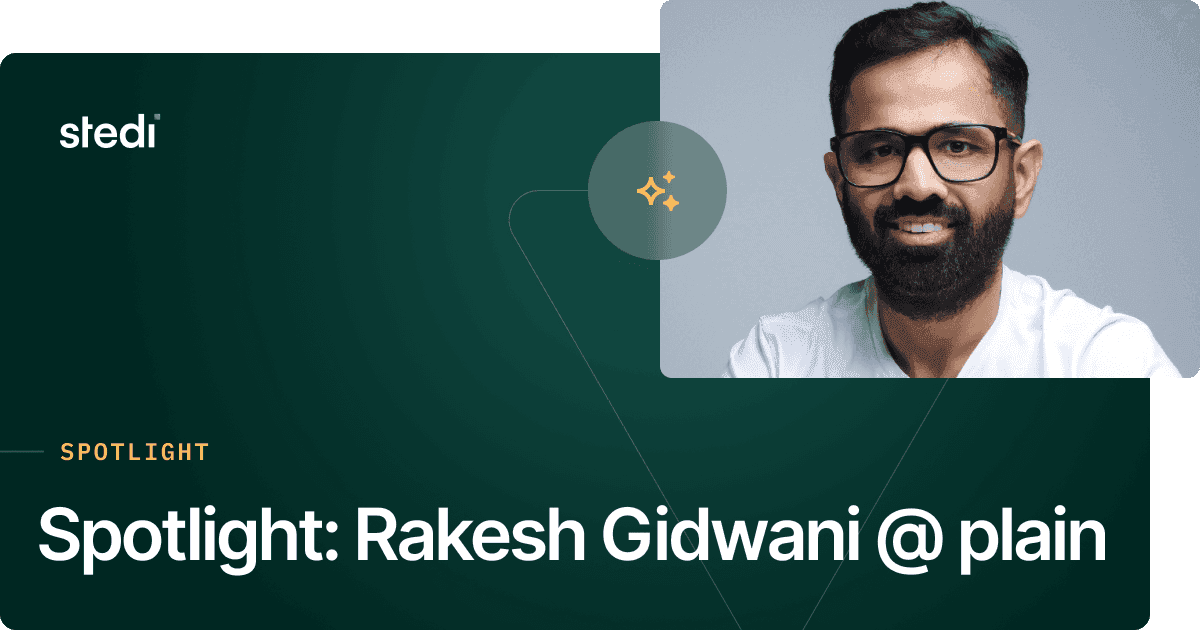
A spotlight is a short-form interview with a leader in health tech. In this spotlight, you'll hear from Rakesh Gidwani, founder of plain.

What does plain do?

plain is a spec-driven platform that converts structured system specifications into production-grade software components (services, databases, agents).

Instead of hand-coding backend services, integrations, and automation workflows, plain enables teams to define their system using specifications and generates scalable, deployable services and autonomous agents.

In healthcare, plain integrates directly with payer networks through platforms like Stedi, allowing teams to ship API-native claims, remittance, and denial workflows in weeks rather than months. plain focuses on building durable systems that run in production, not prototypes.

How did you end up working in health tech?

I did not initially plan to focus on healthcare, but personal experience with how fragmented and opaque the U.S. healthcare system felt pushed me to look deeper.

As I shared plain’s vision with operators across industries, conversations with healthcare teams revealed a massive structural problem built on legacy systems, manual workflows, and disconnected data. The scale of administrative waste and operational friction made it clear that this was not just another vertical but a place where a spec-driven approach to generating secure, compliant, production-grade systems could have real impact.

When plain successfully deployed multiple healthcare agents against live payer networks in a matter of days, it confirmed that this was not a prototype experiment but a practical path toward automating work that should no longer be manual.

How does your role intersect with revenue cycle management (RCM)?

plain intersects with revenue cycle management by serving as the strategic software and infrastructure layer for modernizing healthcare operations.

Rather than acting as another point solution, plain enables healthcare providers, RCM service firms, and private equity-backed platforms to rebuild claims, remittance, and denial workflows on a modular, API-native architecture powered by AI.

By generating production-grade services and autonomous agents on top of modern integrations like Stedi, plain helps organizations replace brittle legacy systems with scalable, intelligent automation.

The goal is not incremental optimization, but enabling the next generation of healthcare operations to be built on a clean, extensible technology stack.

What do you think RCM will look like two years from now?

Over the next two years, revenue cycle management will shift from manual, rules-based operations to AI-driven systems operating directly on top of modern healthcare infrastructure.

Much of the repetitive work performed today by billing teams, denial specialists, and follow-up staff will be handled by LLM-powered agents that can reason over structured data and take action through APIs like Stedi.

These agents will not be rigid, pre-programmed workflows, but adaptive systems that combine payer integrations, EDI data, and decision logic to resolve issues autonomously.

The organizations that win will be those that move from headcount-heavy operations to agent-augmented platforms built on modern, modular infrastructure.

Spotlight: Rakesh Gidwani @ plain

A spotlight is a short-form interview with a leader in health tech. In this spotlight, you'll hear from Rakesh Gidwani, founder of plain.

What does plain do?

plain is a spec-driven platform that converts structured system specifications into production-grade software components (services, databases, agents).

Instead of hand-coding backend services, integrations, and automation workflows, plain enables teams to define their system using specifications and generates scalable, deployable services and autonomous agents.

In healthcare, plain integrates directly with payer networks through platforms like Stedi, allowing teams to ship API-native claims, remittance, and denial workflows in weeks rather than months. plain focuses on building durable systems that run in production, not prototypes.

How did you end up working in health tech?

I did not initially plan to focus on healthcare, but personal experience with how fragmented and opaque the U.S. healthcare system felt pushed me to look deeper.

As I shared plain’s vision with operators across industries, conversations with healthcare teams revealed a massive structural problem built on legacy systems, manual workflows, and disconnected data. The scale of administrative waste and operational friction made it clear that this was not just another vertical but a place where a spec-driven approach to generating secure, compliant, production-grade systems could have real impact.

When plain successfully deployed multiple healthcare agents against live payer networks in a matter of days, it confirmed that this was not a prototype experiment but a practical path toward automating work that should no longer be manual.

How does your role intersect with revenue cycle management (RCM)?

plain intersects with revenue cycle management by serving as the strategic software and infrastructure layer for modernizing healthcare operations.

Rather than acting as another point solution, plain enables healthcare providers, RCM service firms, and private equity-backed platforms to rebuild claims, remittance, and denial workflows on a modular, API-native architecture powered by AI.

By generating production-grade services and autonomous agents on top of modern integrations like Stedi, plain helps organizations replace brittle legacy systems with scalable, intelligent automation.

The goal is not incremental optimization, but enabling the next generation of healthcare operations to be built on a clean, extensible technology stack.

What do you think RCM will look like two years from now?

Over the next two years, revenue cycle management will shift from manual, rules-based operations to AI-driven systems operating directly on top of modern healthcare infrastructure.

Much of the repetitive work performed today by billing teams, denial specialists, and follow-up staff will be handled by LLM-powered agents that can reason over structured data and take action through APIs like Stedi.

These agents will not be rigid, pre-programmed workflows, but adaptive systems that combine payer integrations, EDI data, and decision logic to resolve issues autonomously.

The organizations that win will be those that move from headcount-heavy operations to agent-augmented platforms built on modern, modular infrastructure.

Share

Twitter
LinkedIn

Get started with Stedi

Get started with Stedi

Automate healthcare transactions with developer-friendly APIs that support thousands of payers. Contact us to learn more and speak to the team.

Get updates on what’s new at Stedi

Get updates on what’s new at Stedi

Get updates on what’s new at Stedi

Get updates on what’s new at Stedi

Backed by

Stedi and the S design mark are registered trademarks of Stedi, Inc. All names, logos, and brands of third parties listed on our site are trademarks of their respective owners (including “X12”, which is a trademark of X12 Incorporated). Stedi, Inc. and its products and services are not endorsed by, sponsored by, or affiliated with these third parties. Our use of these names, logos, and brands is for identification purposes only, and does not imply any such endorsement, sponsorship, or affiliation.

Get updates on what’s new at Stedi

Backed by

Stedi and the S design mark are registered trademarks of Stedi, Inc. All names, logos, and brands of third parties listed on our site are trademarks of their respective owners (including “X12”, which is a trademark of X12 Incorporated). Stedi, Inc. and its products and services are not endorsed by, sponsored by, or affiliated with these third parties. Our use of these names, logos, and brands is for identification purposes only, and does not imply any such endorsement, sponsorship, or affiliation.

Get updates on what’s new at Stedi

Backed by

Stedi and the S design mark are registered trademarks of Stedi, Inc. All names, logos, and brands of third parties listed on our site are trademarks of their respective owners (including “X12”, which is a trademark of X12 Incorporated). Stedi, Inc. and its products and services are not endorsed by, sponsored by, or affiliated with these third parties. Our use of these names, logos, and brands is for identification purposes only, and does not imply any such endorsement, sponsorship, or affiliation.