Spotlight: Sam Schwager @ SuperDial
Feb 5, 2026
Spotlight

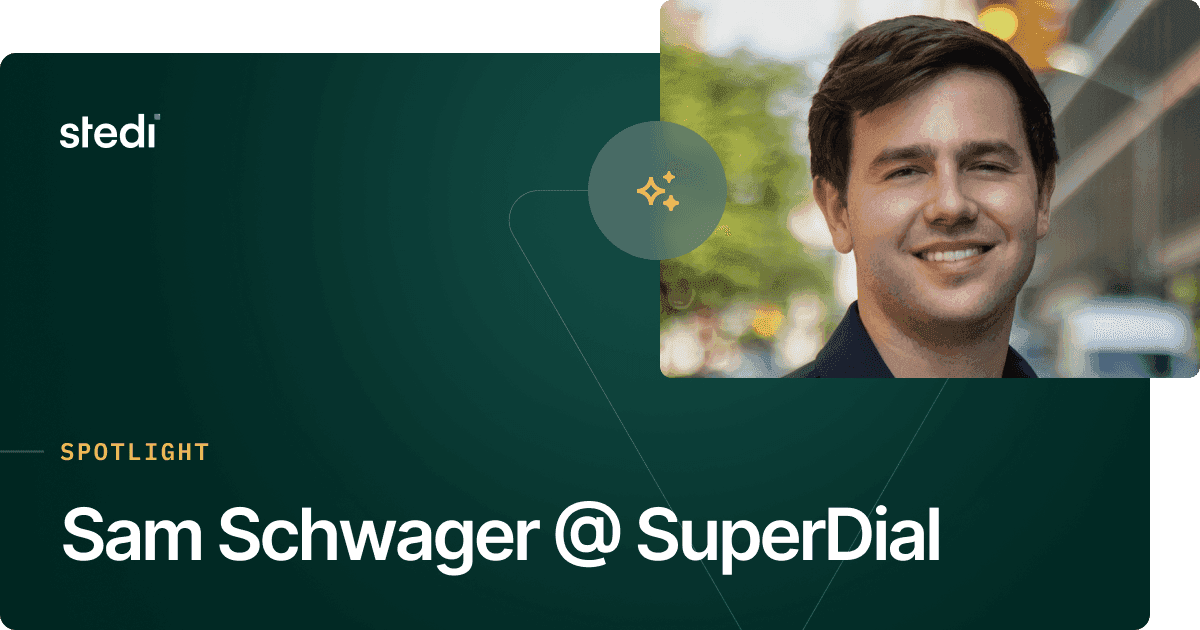
A spotlight is a short-form interview with a leader in health tech. In this spotlight, you'll hear from Sam Schwager, co-Founder and CEO of SuperDial.
What does SuperDial do?
SuperDial uses voice AI to automate high‑volume phone calls in revenue cycle management.
We’re focused on the calls that billing teams and RCM companies spend an enormous amount of time on – things like benefits verification (VOB), prior auth, claim status checks, and denial follow‑ups (and related workflows like credentialing/enrollment).
A big differentiator for us is our Forward Deployed Engineering model, allowing interoperability with all major EHRs, EMRs, and ERPs/CRMs.
How did you end up working in health tech?
My background is in AI – I did my undergrad and master’s at Stanford, and my master’s was in computer science with an AI focus.
My co‑founder and I originally built in healthcare and ultimately started a tech‑forward RCM business (SuperBill) focused on helping specialty practices get reimbursed.
While running that business, we were forced to make a ton of payer phone calls – and that pain point made it obvious there was a much bigger opportunity.
We built an internal tool to automate those calls, realized it was finally possible with modern AI (but extremely hard to do well), and we pivoted to focus entirely on SuperDial.
How does your role intersect with revenue cycle management (RCM)?
RCM is the core of what we do, and it’s also where we came from.
As CEO of SuperDial, my role is to lead a company that is actively shaping how revenue cycle management is done through automation.
I set the product and go-to-market strategy around which RCM workflows we automate first, such as benefits verification, prior authorizations, claim status follow-ups, and denials.
I work directly with providers, payers, and RCM organizations to translate real-world billing operations into production voice agents that deliver measurable results.
What do you think RCM will look like two years from now?
I expect payers to adopt more automation on their side, and we’ll start shifting from “AI calling a human over the phone” toward AI‑to‑AI exchanges that are more efficient.
The net impact should be faster reimbursement cycles, higher productivity per biller, and real progress toward reducing the massive administrative burden that makes healthcare so expensive and frustrating today.

A spotlight is a short-form interview with a leader in health tech. In this spotlight, you'll hear from Sam Schwager, co-Founder and CEO of SuperDial.
What does SuperDial do?
SuperDial uses voice AI to automate high‑volume phone calls in revenue cycle management.
We’re focused on the calls that billing teams and RCM companies spend an enormous amount of time on – things like benefits verification (VOB), prior auth, claim status checks, and denial follow‑ups (and related workflows like credentialing/enrollment).
A big differentiator for us is our Forward Deployed Engineering model, allowing interoperability with all major EHRs, EMRs, and ERPs/CRMs.
How did you end up working in health tech?
My background is in AI – I did my undergrad and master’s at Stanford, and my master’s was in computer science with an AI focus.
My co‑founder and I originally built in healthcare and ultimately started a tech‑forward RCM business (SuperBill) focused on helping specialty practices get reimbursed.
While running that business, we were forced to make a ton of payer phone calls – and that pain point made it obvious there was a much bigger opportunity.
We built an internal tool to automate those calls, realized it was finally possible with modern AI (but extremely hard to do well), and we pivoted to focus entirely on SuperDial.
How does your role intersect with revenue cycle management (RCM)?
RCM is the core of what we do, and it’s also where we came from.
As CEO of SuperDial, my role is to lead a company that is actively shaping how revenue cycle management is done through automation.
I set the product and go-to-market strategy around which RCM workflows we automate first, such as benefits verification, prior authorizations, claim status follow-ups, and denials.
I work directly with providers, payers, and RCM organizations to translate real-world billing operations into production voice agents that deliver measurable results.
What do you think RCM will look like two years from now?
I expect payers to adopt more automation on their side, and we’ll start shifting from “AI calling a human over the phone” toward AI‑to‑AI exchanges that are more efficient.
The net impact should be faster reimbursement cycles, higher productivity per biller, and real progress toward reducing the massive administrative burden that makes healthcare so expensive and frustrating today.

A spotlight is a short-form interview with a leader in health tech. In this spotlight, you'll hear from Sam Schwager, co-Founder and CEO of SuperDial.
What does SuperDial do?
SuperDial uses voice AI to automate high‑volume phone calls in revenue cycle management.
We’re focused on the calls that billing teams and RCM companies spend an enormous amount of time on – things like benefits verification (VOB), prior auth, claim status checks, and denial follow‑ups (and related workflows like credentialing/enrollment).
A big differentiator for us is our Forward Deployed Engineering model, allowing interoperability with all major EHRs, EMRs, and ERPs/CRMs.
How did you end up working in health tech?
My background is in AI – I did my undergrad and master’s at Stanford, and my master’s was in computer science with an AI focus.
My co‑founder and I originally built in healthcare and ultimately started a tech‑forward RCM business (SuperBill) focused on helping specialty practices get reimbursed.
While running that business, we were forced to make a ton of payer phone calls – and that pain point made it obvious there was a much bigger opportunity.
We built an internal tool to automate those calls, realized it was finally possible with modern AI (but extremely hard to do well), and we pivoted to focus entirely on SuperDial.
How does your role intersect with revenue cycle management (RCM)?
RCM is the core of what we do, and it’s also where we came from.
As CEO of SuperDial, my role is to lead a company that is actively shaping how revenue cycle management is done through automation.
I set the product and go-to-market strategy around which RCM workflows we automate first, such as benefits verification, prior authorizations, claim status follow-ups, and denials.
I work directly with providers, payers, and RCM organizations to translate real-world billing operations into production voice agents that deliver measurable results.
What do you think RCM will look like two years from now?
I expect payers to adopt more automation on their side, and we’ll start shifting from “AI calling a human over the phone” toward AI‑to‑AI exchanges that are more efficient.
The net impact should be faster reimbursement cycles, higher productivity per biller, and real progress toward reducing the massive administrative burden that makes healthcare so expensive and frustrating today.
Share
Get started with Stedi
Automate healthcare transactions with developer-friendly APIs that support thousands of payers. Contact us to learn more and speak to the team.
Get updates on what’s new at Stedi
Developers
Resources
Backed by
Stedi is a registered trademark of Stedi, Inc. All names, logos, and brands of third parties listed on our site are trademarks of their respective owners (including “X12”, which is a trademark of X12 Incorporated). Stedi, Inc. and its products and services are not endorsed by, sponsored by, or affiliated with these third parties. Our use of these names, logos, and brands is for identification purposes only, and does not imply any such endorsement, sponsorship, or affiliation.
Developers
Resources
Backed by
Stedi is a registered trademark of Stedi, Inc. All names, logos, and brands of third parties listed on our site are trademarks of their respective owners (including “X12”, which is a trademark of X12 Incorporated). Stedi, Inc. and its products and services are not endorsed by, sponsored by, or affiliated with these third parties. Our use of these names, logos, and brands is for identification purposes only, and does not imply any such endorsement, sponsorship, or affiliation.
Developers
Resources
Get updates on what’s new at Stedi
Backed by
Stedi is a registered trademark of Stedi, Inc. All names, logos, and brands of third parties listed on our site are trademarks of their respective owners (including “X12”, which is a trademark of X12 Incorporated). Stedi, Inc. and its products and services are not endorsed by, sponsored by, or affiliated with these third parties. Our use of these names, logos, and brands is for identification purposes only, and does not imply any such endorsement, sponsorship, or affiliation.
