Spotlight: Toyin Awe @ WithinLabs
Spotlight

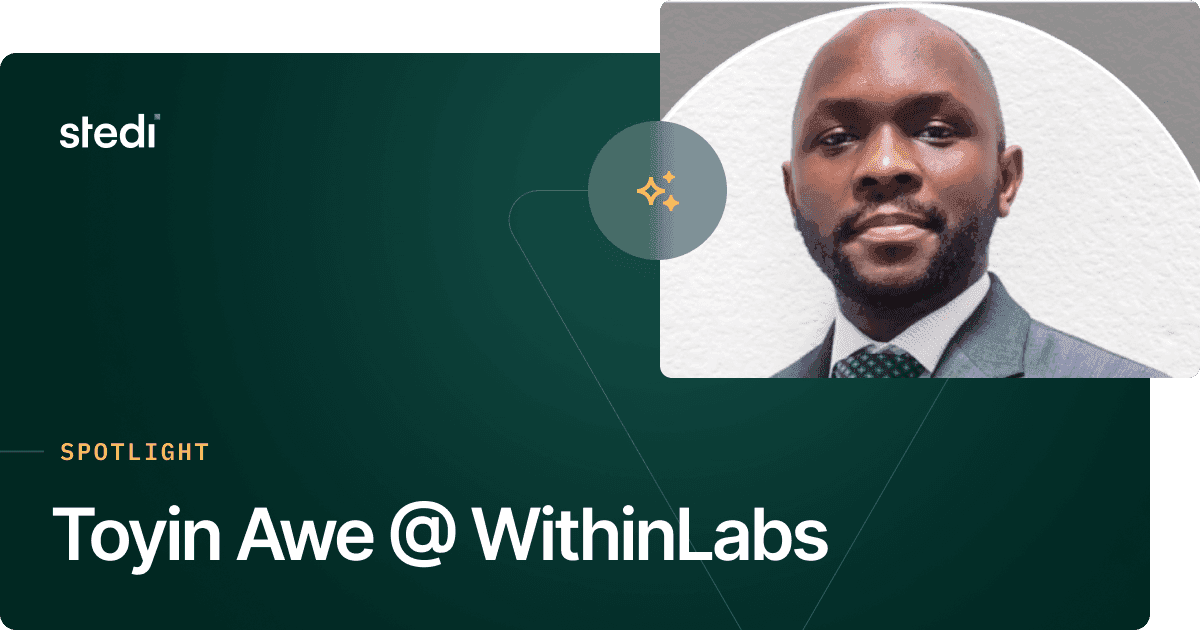
A spotlight is a short-form interview with a leader in health tech. In this spotlight, you'll hear from Toyin Awe, CEO of WithinLabs.

What does WithinLabs do?

WithinLabs is a purpose-driven technology company built around the idea that technology should solve real societal problems. Our flagship product is WithinEHR, an intelligent electronic health records platform designed to streamline healthcare operations, from appointment scheduling to patient history tracking, so clinicians can spend less time on administrative work and more time on patient care.

Behavioral health is a space we care deeply about. It's historically been underserved by health tech, and there's enormous opportunity to build tools that actually reflect how behavioral health care is delivered.

How did you end up working in health tech?

My path was really an evolution of my clinical career. I spent years in behavioral health, first as a clinician and then in a leadership role. And in that world, the technology problem is especially acute. Behavioral health has some of the most complex documentation requirements, clinical notes, billing, treatment plans, prior authorizations that get denied at staggering rates, and yet the tools clinicians are given are often outdated.

I watched providers spend more time navigating their fragmented legacy EHR than engaging with patients. That frustration became a calling. Moving into the CPO role at WithinLabs felt like the natural next step, a chance to actually fix those problems from the inside, rather than just working around them.

How does your role intersect with revenue cycle management (RCM)?

Behavioral health gave me a front-row seat to how brutal RCM can be when the system isn't designed well. Mental health parity is supposed to guarantee equal coverage, but in practice, prior authorization denial rates in behavioral health are among the highest in all of medicine. A lot of that comes down to documentation. If a clinical note doesn't capture the right clinical language, the claim gets denied, the provider spends hours on appeals, and the patient's care gets disrupted.

As CPO, I think about that constantly. The way we design clinical workflows in WithinEHR directly affects coding accuracy, charge capture, and how cleanly a claim moves through the cycle. My clinical background means I know exactly where documentation breaks down at the point of care, and that's precisely where the product has to get it right.

What do you think RCM will look like two years from now?

I think we're heading toward a much more automated and clinically integrated RCM.

So much of what's manual today, prior authorizations, denial management, coding reviews, will be handled by AI, with humans focused on exceptions. But what I'm most focused on, coming from a clinical background, is closing the gap between clinical documentation and the revenue cycle. Right now they're treated as separate concerns, and that disconnect is where revenue leaks. In behavioral health especially, a therapist or psychiatric NP or psychiatrist shouldn't have to think about billing, they should focus on patient care, and the system should handle the rest. Clean claims as a byproduct of good clinical care.

That's what we're building toward at WithinLabs. WithinEHR is an all-in-one, AI-native product built on that premise. Scheduling, documentation, billing, and outcomes measurement aren't four separate modules bolted together; they're one continuous workflow, where each piece informs the next. When a clinician writes a note, the system isn't just storing text. It's reading clinical intent, mapping to the right CPT and ICD-10 codes, flagging medical necessity language, and queuing a clean claim, all before the provider ever closes the encounter. The administrative burden that burns out so many behavioral health clinicians today becomes invisible. But the stakes here go beyond efficiency.

Behavioral health has one of the most complex payer reimbursement environments in all of healthcare. Denials are high, underpayment is rampant, and smaller practices, the ones serving the most vulnerable populations, often don't have the billing expertise to fight back. That's not just a revenue problem. It's an access and equity problem. When a solo provider in an underserved community spends hours on prior authorizations and claims corrections, they're spending less time with patients. When they can't get paid reliably, they stop accepting insurance altogether. The disparity gap widens.

AI-native RCM, done right, is a health equity intervention. When we reduce the friction between clinical care and reimbursement, we make it economically viable for behavioral health providers to stay in-network, take on more complex cases, and serve communities that have historically been underserved. WithinEHR is built with that mission in mind because better documentation doesn't just mean cleaner claims, it means better outcomes data, better continuity of care, and a system that finally treats behavioral health as the medical specialty it is. The future we're building toward isn't just automation for its own sake. It's a model where the clinician's only job is to be present with their patient, and where everything downstream takes care of itself.

A spotlight is a short-form interview with a leader in health tech. In this spotlight, you'll hear from Toyin Awe, CEO of WithinLabs.

What does WithinLabs do?

WithinLabs is a purpose-driven technology company built around the idea that technology should solve real societal problems. Our flagship product is WithinEHR, an intelligent electronic health records platform designed to streamline healthcare operations, from appointment scheduling to patient history tracking, so clinicians can spend less time on administrative work and more time on patient care.

Behavioral health is a space we care deeply about. It's historically been underserved by health tech, and there's enormous opportunity to build tools that actually reflect how behavioral health care is delivered.

How did you end up working in health tech?

My path was really an evolution of my clinical career. I spent years in behavioral health, first as a clinician and then in a leadership role. And in that world, the technology problem is especially acute. Behavioral health has some of the most complex documentation requirements, clinical notes, billing, treatment plans, prior authorizations that get denied at staggering rates, and yet the tools clinicians are given are often outdated.

I watched providers spend more time navigating their fragmented legacy EHR than engaging with patients. That frustration became a calling. Moving into the CPO role at WithinLabs felt like the natural next step, a chance to actually fix those problems from the inside, rather than just working around them.

How does your role intersect with revenue cycle management (RCM)?

Behavioral health gave me a front-row seat to how brutal RCM can be when the system isn't designed well. Mental health parity is supposed to guarantee equal coverage, but in practice, prior authorization denial rates in behavioral health are among the highest in all of medicine. A lot of that comes down to documentation. If a clinical note doesn't capture the right clinical language, the claim gets denied, the provider spends hours on appeals, and the patient's care gets disrupted.

As CPO, I think about that constantly. The way we design clinical workflows in WithinEHR directly affects coding accuracy, charge capture, and how cleanly a claim moves through the cycle. My clinical background means I know exactly where documentation breaks down at the point of care, and that's precisely where the product has to get it right.

What do you think RCM will look like two years from now?

I think we're heading toward a much more automated and clinically integrated RCM.

So much of what's manual today, prior authorizations, denial management, coding reviews, will be handled by AI, with humans focused on exceptions. But what I'm most focused on, coming from a clinical background, is closing the gap between clinical documentation and the revenue cycle. Right now they're treated as separate concerns, and that disconnect is where revenue leaks. In behavioral health especially, a therapist or psychiatric NP or psychiatrist shouldn't have to think about billing, they should focus on patient care, and the system should handle the rest. Clean claims as a byproduct of good clinical care.

That's what we're building toward at WithinLabs. WithinEHR is an all-in-one, AI-native product built on that premise. Scheduling, documentation, billing, and outcomes measurement aren't four separate modules bolted together; they're one continuous workflow, where each piece informs the next. When a clinician writes a note, the system isn't just storing text. It's reading clinical intent, mapping to the right CPT and ICD-10 codes, flagging medical necessity language, and queuing a clean claim, all before the provider ever closes the encounter. The administrative burden that burns out so many behavioral health clinicians today becomes invisible. But the stakes here go beyond efficiency.

Behavioral health has one of the most complex payer reimbursement environments in all of healthcare. Denials are high, underpayment is rampant, and smaller practices, the ones serving the most vulnerable populations, often don't have the billing expertise to fight back. That's not just a revenue problem. It's an access and equity problem. When a solo provider in an underserved community spends hours on prior authorizations and claims corrections, they're spending less time with patients. When they can't get paid reliably, they stop accepting insurance altogether. The disparity gap widens.

AI-native RCM, done right, is a health equity intervention. When we reduce the friction between clinical care and reimbursement, we make it economically viable for behavioral health providers to stay in-network, take on more complex cases, and serve communities that have historically been underserved. WithinEHR is built with that mission in mind because better documentation doesn't just mean cleaner claims, it means better outcomes data, better continuity of care, and a system that finally treats behavioral health as the medical specialty it is. The future we're building toward isn't just automation for its own sake. It's a model where the clinician's only job is to be present with their patient, and where everything downstream takes care of itself.

Share

Twitter
LinkedIn

Get started with Stedi

Get started with Stedi

Automate healthcare transactions with developer-friendly APIs that support thousands of payers. Contact us to learn more and speak to the team.

Get updates on what’s new at Stedi

Get updates on what’s new at Stedi

Get updates on what’s new at Stedi

Get updates on what’s new at Stedi

Backed by

Stedi and the S design mark are registered trademarks of Stedi, Inc. All names, logos, and brands of third parties listed on our site are trademarks of their respective owners (including “X12”, which is a trademark of X12 Incorporated). Stedi, Inc. and its products and services are not endorsed by, sponsored by, or affiliated with these third parties. Our use of these names, logos, and brands is for identification purposes only, and does not imply any such endorsement, sponsorship, or affiliation.

Get updates on what’s new at Stedi

Backed by

Stedi and the S design mark are registered trademarks of Stedi, Inc. All names, logos, and brands of third parties listed on our site are trademarks of their respective owners (including “X12”, which is a trademark of X12 Incorporated). Stedi, Inc. and its products and services are not endorsed by, sponsored by, or affiliated with these third parties. Our use of these names, logos, and brands is for identification purposes only, and does not imply any such endorsement, sponsorship, or affiliation.

Get updates on what’s new at Stedi

Backed by

Stedi and the S design mark are registered trademarks of Stedi, Inc. All names, logos, and brands of third parties listed on our site are trademarks of their respective owners (including “X12”, which is a trademark of X12 Incorporated). Stedi, Inc. and its products and services are not endorsed by, sponsored by, or affiliated with these third parties. Our use of these names, logos, and brands is for identification purposes only, and does not imply any such endorsement, sponsorship, or affiliation.