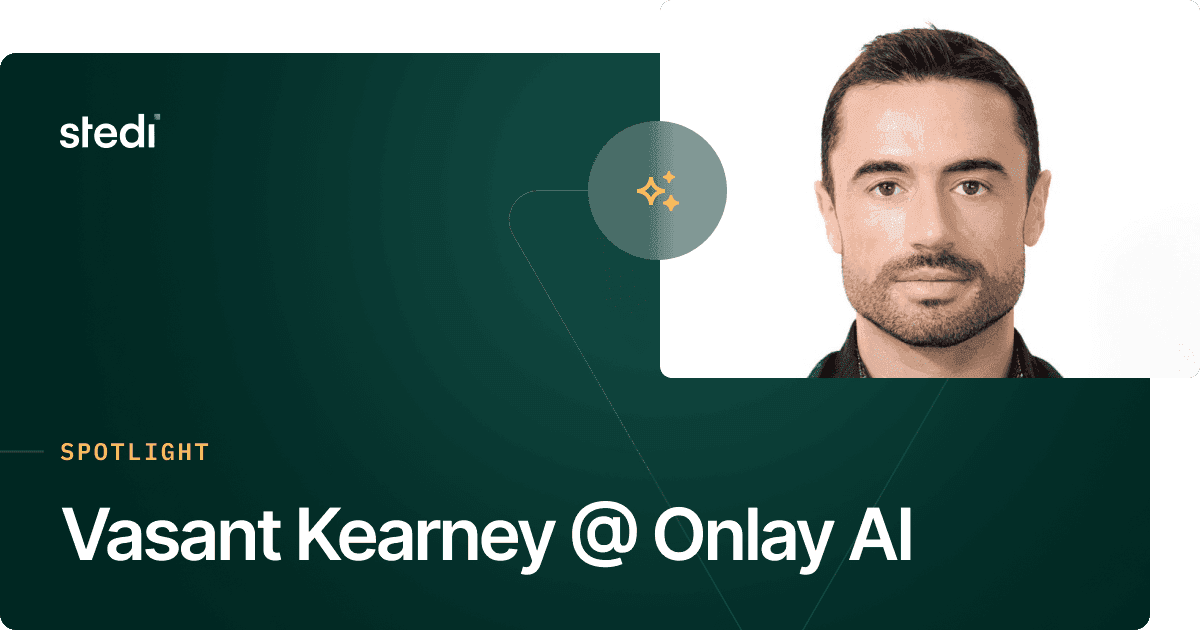
Spotlight: Vasant Kearney @ Onlay AI
Spotlight

A spotlight is a short-form interview with a leader in health tech. In this spotlight, you'll hear from Vasant Kearney, CEO of Onlay AI.
What does Onlay AI do?
Onlay AI builds agentic automation for dental revenue cycle management, a digital teammate that works a claim from eligibility through payment posting.
We automate eligibility and benefits checks, claim creation and submission, clinical attachments, and payment posting and reconciliation so practices and DSOs get paid faster with fewer denials and less manual work.
Under the hood, we are pioneers in deploying multi-step, chain-of-thought reasoning agents that can safely call tools and generate the workflow code needed to handle payer-specific rules across payer portals, clearinghouses like Stedi, and practice management systems.
We push the frontier of what tool-using agents can do in production, while keeping safety first through least privilege access, PHI-aware data handling, auditable action logs, and clear human escalation when something is uncertain.
How did you end up working in health tech?
I’ve always been drawn to systems problems where small improvements compound, and healthcare is one of the few places where better automation immediately helps both staff and patients.
When I looked closely at dental billing, I was surprised by how much work still depends on manual portal navigation, repetitive data entry, and tracking down missing documentation. Modern AI can take that burden off teams, but only if you build for reliability, privacy, and security from day one. That belief is what pushed me to start Onlay AI.
How does your role intersect with revenue cycle management (RCM)?
I’m an AI specialist focused on turning real-world RCM work into reliable automation. I spend time with billing teams to understand payer rules, failure modes, and what evidence actually gets a claim paid, then I translate that into agent workflows that plan, take actions, and verify results across eligibility, claim assembly, attachments, submission, follow-up, and payment posting.
Technically, I work on agentic tool calling and code writing, building agents that can use APIs and browser automation safely, generate the small bits of logic needed for transformations and validations, and check their work before moving forward. Because we operate in a PHI environment, I also invest heavily in safety and trust through permissioning, monitoring, auditability, and handoffs to humans when confidence is low or policy requires review.
What do you think RCM will look like two years from now?
In two years, RCM will feel less like working endless queues and more like supervising exception handling. Routine work such as real-time eligibility, clean claim preparation, attachment gathering, status checks, and payment posting will increasingly be handled by agents that run continuously in the background, with humans focused on edge cases, payer disputes, and patient communication.
The differentiator will be who can make agents safe and predictable in production with strong evaluation harnesses, monitoring, policy driven guardrails, and auditable action logs. For dental practices and DSOs, that means faster cash, fewer write-offs, and a smaller administrative burden, with AI safety and compliance treated as table stakes rather than afterthoughts.

A spotlight is a short-form interview with a leader in health tech. In this spotlight, you'll hear from Vasant Kearney, CEO of Onlay AI.
What does Onlay AI do?
Onlay AI builds agentic automation for dental revenue cycle management, a digital teammate that works a claim from eligibility through payment posting.
We automate eligibility and benefits checks, claim creation and submission, clinical attachments, and payment posting and reconciliation so practices and DSOs get paid faster with fewer denials and less manual work.
Under the hood, we are pioneers in deploying multi-step, chain-of-thought reasoning agents that can safely call tools and generate the workflow code needed to handle payer-specific rules across payer portals, clearinghouses like Stedi, and practice management systems.
We push the frontier of what tool-using agents can do in production, while keeping safety first through least privilege access, PHI-aware data handling, auditable action logs, and clear human escalation when something is uncertain.
How did you end up working in health tech?
I’ve always been drawn to systems problems where small improvements compound, and healthcare is one of the few places where better automation immediately helps both staff and patients.
When I looked closely at dental billing, I was surprised by how much work still depends on manual portal navigation, repetitive data entry, and tracking down missing documentation. Modern AI can take that burden off teams, but only if you build for reliability, privacy, and security from day one. That belief is what pushed me to start Onlay AI.
How does your role intersect with revenue cycle management (RCM)?
I’m an AI specialist focused on turning real-world RCM work into reliable automation. I spend time with billing teams to understand payer rules, failure modes, and what evidence actually gets a claim paid, then I translate that into agent workflows that plan, take actions, and verify results across eligibility, claim assembly, attachments, submission, follow-up, and payment posting.
Technically, I work on agentic tool calling and code writing, building agents that can use APIs and browser automation safely, generate the small bits of logic needed for transformations and validations, and check their work before moving forward. Because we operate in a PHI environment, I also invest heavily in safety and trust through permissioning, monitoring, auditability, and handoffs to humans when confidence is low or policy requires review.
What do you think RCM will look like two years from now?
In two years, RCM will feel less like working endless queues and more like supervising exception handling. Routine work such as real-time eligibility, clean claim preparation, attachment gathering, status checks, and payment posting will increasingly be handled by agents that run continuously in the background, with humans focused on edge cases, payer disputes, and patient communication.
The differentiator will be who can make agents safe and predictable in production with strong evaluation harnesses, monitoring, policy driven guardrails, and auditable action logs. For dental practices and DSOs, that means faster cash, fewer write-offs, and a smaller administrative burden, with AI safety and compliance treated as table stakes rather than afterthoughts.
Share
Get started with Stedi
Automate healthcare transactions with developer-friendly APIs that support thousands of payers. Contact us to learn more and speak to the team.
Get updates on what’s new at Stedi
Product
Developers
Resources
Backed by
Stedi and the S design mark are registered trademarks of Stedi, Inc. All names, logos, and brands of third parties listed on our site are trademarks of their respective owners (including “X12”, which is a trademark of X12 Incorporated). Stedi, Inc. and its products and services are not endorsed by, sponsored by, or affiliated with these third parties. Our use of these names, logos, and brands is for identification purposes only, and does not imply any such endorsement, sponsorship, or affiliation.
Product
Developers
Resources
Backed by
Stedi and the S design mark are registered trademarks of Stedi, Inc. All names, logos, and brands of third parties listed on our site are trademarks of their respective owners (including “X12”, which is a trademark of X12 Incorporated). Stedi, Inc. and its products and services are not endorsed by, sponsored by, or affiliated with these third parties. Our use of these names, logos, and brands is for identification purposes only, and does not imply any such endorsement, sponsorship, or affiliation.
Product
Developers
Resources
Get updates on what’s new at Stedi
Backed by
Stedi and the S design mark are registered trademarks of Stedi, Inc. All names, logos, and brands of third parties listed on our site are trademarks of their respective owners (including “X12”, which is a trademark of X12 Incorporated). Stedi, Inc. and its products and services are not endorsed by, sponsored by, or affiliated with these third parties. Our use of these names, logos, and brands is for identification purposes only, and does not imply any such endorsement, sponsorship, or affiliation.
