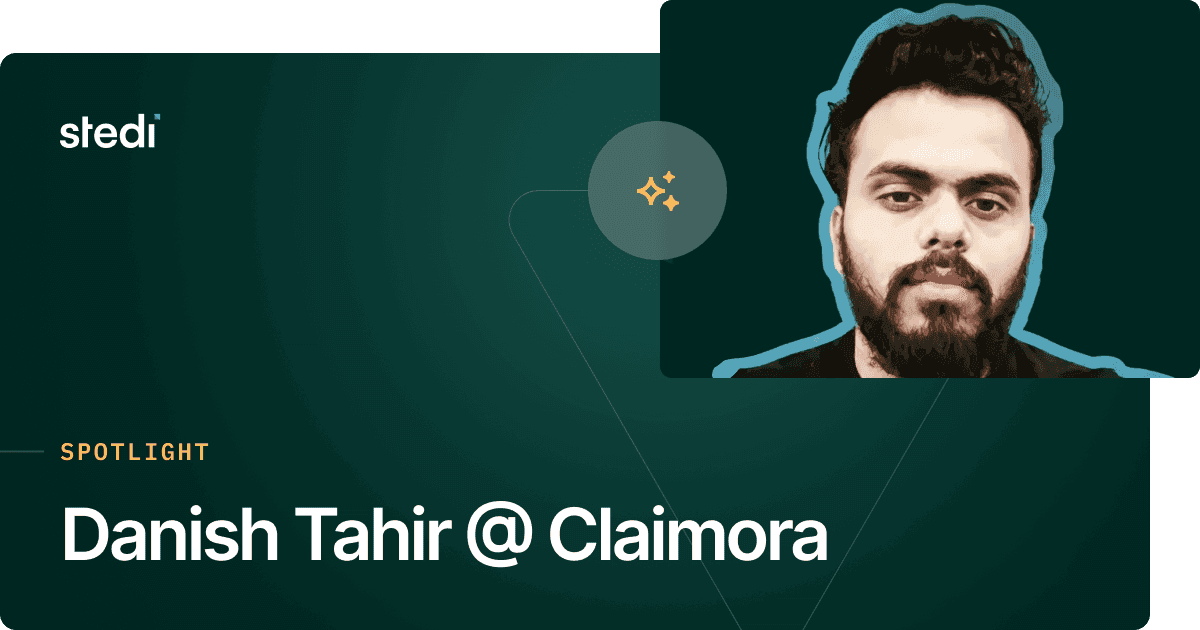
Spotlight: Danish Tahir @ Claimora
Jan 5, 2026

Spotlight

Spotlight: Danish Tahir @ Claimora

A spotlight is a short-form interview with a leader in health tech. In this spotlight, you'll hear from Danish Tahir, founder of Claimora.

What does Claimora do?

Claimora is an intelligent Recovery Engine that transforms medical billing from a manual 're-work' process into an autonomous workflow.

We use a multi-agent AI system – which we call our 'Digital Workforce' – to identify, analyze, and resolve insurance denials in real-time. By combining Stedi’s deep connectivity with advanced reasoning models, Claimora doesn't just tell a clinic why a claim was denied; it actively fixes the coding, verifies the eligibility, and drafts the clinical appeals without human intervention.

How did you end up working in health tech? 

I spent over 8 years as a Laravel developer building complex, high-scale systems, but I was always drawn to industries where technical 'toil' had a real-world cost.

When I saw the massive inefficiency in the US revenue cycle – where billions are lost simply because systems can't 'talk' to each other or reason through complex payer rules – I knew my background in orchestration and rapid development could make an impact. I wanted to build the 'plumbing' that ensures doctors get paid for the care they actually provide.

How does your role intersect with revenue cycle management (RCM)?

My role is that of an Architect of Autonomy. In traditional RCM, people are the 'glue' between disconnected software. My intersection is at the 'Action Layer.'

I use Stedi’s APIs as the nervous system – gathering the data from ERAs and eligibility checks – and then I build the 'Brain' (the AI Agents) that acts on that data. I’m moving RCM away from 'Data Entry' and toward 'Exception Management,' where humans only step in for the most complex 5% of cases while the system handles the rest.

What do you think RCM will look like two years from now?

Two years from now, RCM will be Agentic and Invisible. We are moving away from monolithic 'Billing Software' and toward specialized AI Agent Squads.

Instead of a biller spending 20 minutes researching a single 'Medical Necessity' denial, they will oversee a fleet of digital agents that have already gathered the clinical notes, cited the specific payer policy, and prepared the appeal package.

The 'Revenue Cycle' won't be a cycle of rework anymore; it will be a straight line from patient encounter to payment, powered by autonomous systems that learn and adapt to payer rule changes in real-time.

Spotlight: Danish Tahir @ Claimora

A spotlight is a short-form interview with a leader in health tech. In this spotlight, you'll hear from Danish Tahir, founder of Claimora.

What does Claimora do?

Claimora is an intelligent Recovery Engine that transforms medical billing from a manual 're-work' process into an autonomous workflow.

We use a multi-agent AI system – which we call our 'Digital Workforce' – to identify, analyze, and resolve insurance denials in real-time. By combining Stedi’s deep connectivity with advanced reasoning models, Claimora doesn't just tell a clinic why a claim was denied; it actively fixes the coding, verifies the eligibility, and drafts the clinical appeals without human intervention.

How did you end up working in health tech? 

I spent over 8 years as a Laravel developer building complex, high-scale systems, but I was always drawn to industries where technical 'toil' had a real-world cost.

When I saw the massive inefficiency in the US revenue cycle – where billions are lost simply because systems can't 'talk' to each other or reason through complex payer rules – I knew my background in orchestration and rapid development could make an impact. I wanted to build the 'plumbing' that ensures doctors get paid for the care they actually provide.

How does your role intersect with revenue cycle management (RCM)?

My role is that of an Architect of Autonomy. In traditional RCM, people are the 'glue' between disconnected software. My intersection is at the 'Action Layer.'

I use Stedi’s APIs as the nervous system – gathering the data from ERAs and eligibility checks – and then I build the 'Brain' (the AI Agents) that acts on that data. I’m moving RCM away from 'Data Entry' and toward 'Exception Management,' where humans only step in for the most complex 5% of cases while the system handles the rest.

What do you think RCM will look like two years from now?

Two years from now, RCM will be Agentic and Invisible. We are moving away from monolithic 'Billing Software' and toward specialized AI Agent Squads.

Instead of a biller spending 20 minutes researching a single 'Medical Necessity' denial, they will oversee a fleet of digital agents that have already gathered the clinical notes, cited the specific payer policy, and prepared the appeal package.

The 'Revenue Cycle' won't be a cycle of rework anymore; it will be a straight line from patient encounter to payment, powered by autonomous systems that learn and adapt to payer rule changes in real-time.

Spotlight: Danish Tahir @ Claimora

A spotlight is a short-form interview with a leader in health tech. In this spotlight, you'll hear from Danish Tahir, founder of Claimora.

What does Claimora do?

Claimora is an intelligent Recovery Engine that transforms medical billing from a manual 're-work' process into an autonomous workflow.

We use a multi-agent AI system – which we call our 'Digital Workforce' – to identify, analyze, and resolve insurance denials in real-time. By combining Stedi’s deep connectivity with advanced reasoning models, Claimora doesn't just tell a clinic why a claim was denied; it actively fixes the coding, verifies the eligibility, and drafts the clinical appeals without human intervention.

How did you end up working in health tech? 

I spent over 8 years as a Laravel developer building complex, high-scale systems, but I was always drawn to industries where technical 'toil' had a real-world cost.

When I saw the massive inefficiency in the US revenue cycle – where billions are lost simply because systems can't 'talk' to each other or reason through complex payer rules – I knew my background in orchestration and rapid development could make an impact. I wanted to build the 'plumbing' that ensures doctors get paid for the care they actually provide.

How does your role intersect with revenue cycle management (RCM)?

My role is that of an Architect of Autonomy. In traditional RCM, people are the 'glue' between disconnected software. My intersection is at the 'Action Layer.'

I use Stedi’s APIs as the nervous system – gathering the data from ERAs and eligibility checks – and then I build the 'Brain' (the AI Agents) that acts on that data. I’m moving RCM away from 'Data Entry' and toward 'Exception Management,' where humans only step in for the most complex 5% of cases while the system handles the rest.

What do you think RCM will look like two years from now?

Two years from now, RCM will be Agentic and Invisible. We are moving away from monolithic 'Billing Software' and toward specialized AI Agent Squads.

Instead of a biller spending 20 minutes researching a single 'Medical Necessity' denial, they will oversee a fleet of digital agents that have already gathered the clinical notes, cited the specific payer policy, and prepared the appeal package.

The 'Revenue Cycle' won't be a cycle of rework anymore; it will be a straight line from patient encounter to payment, powered by autonomous systems that learn and adapt to payer rule changes in real-time.

Share

Twitter
LinkedIn

Get started with Stedi

Get started with Stedi

Automate healthcare transactions with developer-friendly APIs that support thousands of payers. Contact us to learn more and speak to the team.

Get updates on what’s new at Stedi

Get updates on what’s new at Stedi

Get updates on what’s new at Stedi

Get updates on what’s new at Stedi

Backed by

Stedi is a registered trademark of Stedi, Inc. All names, logos, and brands of third parties listed on our site are trademarks of their respective owners (including “X12”, which is a trademark of X12 Incorporated). Stedi, Inc. and its products and services are not endorsed by, sponsored by, or affiliated with these third parties. Our use of these names, logos, and brands is for identification purposes only, and does not imply any such endorsement, sponsorship, or affiliation.

Get updates on what’s new at Stedi

Backed by

Stedi is a registered trademark of Stedi, Inc. All names, logos, and brands of third parties listed on our site are trademarks of their respective owners (including “X12”, which is a trademark of X12 Incorporated). Stedi, Inc. and its products and services are not endorsed by, sponsored by, or affiliated with these third parties. Our use of these names, logos, and brands is for identification purposes only, and does not imply any such endorsement, sponsorship, or affiliation.

Get updates on what’s new at Stedi

Backed by

Stedi is a registered trademark of Stedi, Inc. All names, logos, and brands of third parties listed on our site are trademarks of their respective owners (including “X12”, which is a trademark of X12 Incorporated). Stedi, Inc. and its products and services are not endorsed by, sponsored by, or affiliated with these third parties. Our use of these names, logos, and brands is for identification purposes only, and does not imply any such endorsement, sponsorship, or affiliation.