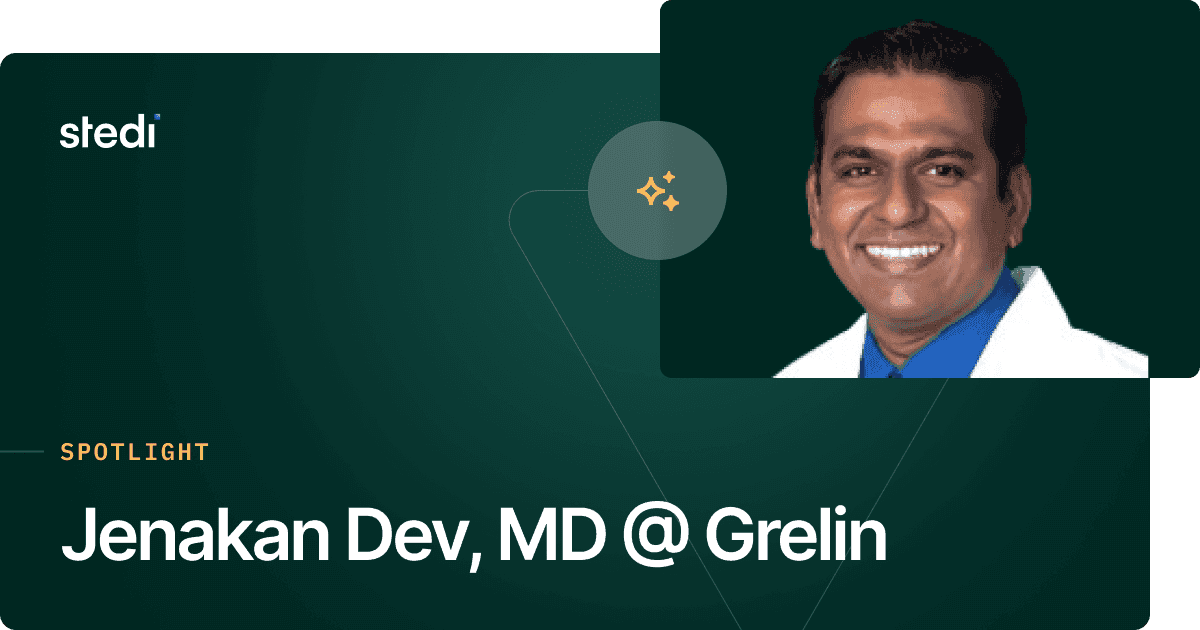
Spotlight: Jenakan Dev, MD @ Grelin
Spotlight

Spotlight: Jenakan Dev, MD @ Grelin

A spotlight is a short-form interview with a leader in health tech. In this spotlight, you'll hear from Jenakan Dev, MD, founder of Grelin.

Title: Founder

LinkedIn: https://www.linkedin.com/in/jenakan-dev-52a2801bb/

What does Grelin do?

Grelin is an AI intelligence layer on top of existing healthcare systems and analyzes documentation and claims before submission to prevent denials and capture missed reimbursement.

Leveraging this AI Intelligence infrastructure, we are able to rapidly deploy domain-specific point solutions serving the specific billing needs of various specialties.

Our solutions and products improve revenue, decrease denials and rework by RCM teams, all without replacing systems or disrupting workflows.

How did you end up working in health tech?

I actually started my career in computer science before going into medicine. So I’ve always had one foot in technology and one in healthcare.

When I began practicing as a physician, I quickly saw how inefficient the revenue cycle really was. After every patient encounter, my notes would go to medical coders… sometimes back to me… then into billing. It was a constant loop of interpretation, corrections, and delays. And that’s where a lot of errors start.

The more I looked into it, the clearer it became that most denied claims don’t start in billing; they start much earlier in the workflow.

With the advances we’re seeing in AI today, I realized there’s a much better way to solve this problem. Instead of fixing claims after they’re denied, we can validate the documentation, coding, and payer requirements before the claim is ever submitted.

That’s the idea behind Grelin.

How does your role intersect with revenue cycle management (RCM)?

My role as CEO of Grelin is focused upstream, in what we call Pre-Billing Revenue Integrity.

That means ensuring every claim is valid before it is ever submitted. Eligibility is verified correctly. Documentation supports medical necessity. Coding aligns with payer policy. Prior authorizations are in place. In other words, we are engineering clean claims at the source.

So while we absolutely intersect with RCM, we are not another RCM vendor. We are the intelligence layer that makes RCM more effective. When we do our job right, billing teams inherit clean claims instead of problems, first-pass acceptance rates rise, denials drop, and days in AR compress.

The simplest way to think about it is this:

RCM reports the outcome. Pre-Billing Revenue Integrity determines it.

That is where Grelin lives, and that is where the biggest financial impact exists today.

What do you think RCM will look like two years from now?

Two years from now, RCM will look a lot less like a back-office function and a lot more like a real-time intelligence system.

Right now, most organizations are still reacting. Claims go out, denials come back, teams scramble to fix and resubmit. That model is already breaking under the weight of payer automation.

In two years, four major shifts will define RCM:

1. From Reactive to Predictive
RCM will move upstream. Every claim will be scored before submission, much like a credit decision. Risk will be identified in real time and corrected before it ever hits a payer. Denials will not disappear, but they will no longer be the primary operating metric.

2. From Manual Workflows to Autonomous Systems
The bulk of human-driven tasks will be automated. Prior auth, eligibility validation, coding checks, claim edits, and even follow-ups will run continuously in the background. Teams will shrink in size but increase in impact. The role shifts from doing the work to overseeing the system.

3. From Clearinghouses to Intelligent Infrastructure
Clearinghouses will evolve into API-driven infrastructure layers. The real differentiation will sit above them in intelligence: systems that learn from every submission, every payer response, every remittance, and continuously optimize outcomes.

4. From Billing Departments to Financial Command Centers
RCM leaders, especially CFOs, will have real-time visibility into revenue risk. Not reports after the fact, but forward-looking indicators. Where revenue is leaking, why, and how to fix it before it impacts cash flow.

The way revenue gets managed is about to feel completely different. Instead of reacting after things break, teams will know what is going to happen before it does, fix it automatically, and see the financial impact in real time. The busy work fades out, the systems get smarter with every transaction, and leaders finally have a clear line of sight into where money is won or lost. It becomes less about chasing problems and more about running the business with confidence, where outcomes are not a surprise and performance is something you can actually control.

Spotlight: Jenakan Dev, MD @ Grelin

A spotlight is a short-form interview with a leader in health tech. In this spotlight, you'll hear from Jenakan Dev, MD, founder of Grelin.

Title: Founder

LinkedIn: https://www.linkedin.com/in/jenakan-dev-52a2801bb/

What does Grelin do?

Grelin is an AI intelligence layer on top of existing healthcare systems and analyzes documentation and claims before submission to prevent denials and capture missed reimbursement.

Leveraging this AI Intelligence infrastructure, we are able to rapidly deploy domain-specific point solutions serving the specific billing needs of various specialties.

Our solutions and products improve revenue, decrease denials and rework by RCM teams, all without replacing systems or disrupting workflows.

How did you end up working in health tech?

I actually started my career in computer science before going into medicine. So I’ve always had one foot in technology and one in healthcare.

When I began practicing as a physician, I quickly saw how inefficient the revenue cycle really was. After every patient encounter, my notes would go to medical coders… sometimes back to me… then into billing. It was a constant loop of interpretation, corrections, and delays. And that’s where a lot of errors start.

The more I looked into it, the clearer it became that most denied claims don’t start in billing; they start much earlier in the workflow.

With the advances we’re seeing in AI today, I realized there’s a much better way to solve this problem. Instead of fixing claims after they’re denied, we can validate the documentation, coding, and payer requirements before the claim is ever submitted.

That’s the idea behind Grelin.

How does your role intersect with revenue cycle management (RCM)?

My role as CEO of Grelin is focused upstream, in what we call Pre-Billing Revenue Integrity.

That means ensuring every claim is valid before it is ever submitted. Eligibility is verified correctly. Documentation supports medical necessity. Coding aligns with payer policy. Prior authorizations are in place. In other words, we are engineering clean claims at the source.

So while we absolutely intersect with RCM, we are not another RCM vendor. We are the intelligence layer that makes RCM more effective. When we do our job right, billing teams inherit clean claims instead of problems, first-pass acceptance rates rise, denials drop, and days in AR compress.

The simplest way to think about it is this:

RCM reports the outcome. Pre-Billing Revenue Integrity determines it.

That is where Grelin lives, and that is where the biggest financial impact exists today.

What do you think RCM will look like two years from now?

Two years from now, RCM will look a lot less like a back-office function and a lot more like a real-time intelligence system.

Right now, most organizations are still reacting. Claims go out, denials come back, teams scramble to fix and resubmit. That model is already breaking under the weight of payer automation.

In two years, four major shifts will define RCM:

1. From Reactive to Predictive
RCM will move upstream. Every claim will be scored before submission, much like a credit decision. Risk will be identified in real time and corrected before it ever hits a payer. Denials will not disappear, but they will no longer be the primary operating metric.

2. From Manual Workflows to Autonomous Systems
The bulk of human-driven tasks will be automated. Prior auth, eligibility validation, coding checks, claim edits, and even follow-ups will run continuously in the background. Teams will shrink in size but increase in impact. The role shifts from doing the work to overseeing the system.

3. From Clearinghouses to Intelligent Infrastructure
Clearinghouses will evolve into API-driven infrastructure layers. The real differentiation will sit above them in intelligence: systems that learn from every submission, every payer response, every remittance, and continuously optimize outcomes.

4. From Billing Departments to Financial Command Centers
RCM leaders, especially CFOs, will have real-time visibility into revenue risk. Not reports after the fact, but forward-looking indicators. Where revenue is leaking, why, and how to fix it before it impacts cash flow.

The way revenue gets managed is about to feel completely different. Instead of reacting after things break, teams will know what is going to happen before it does, fix it automatically, and see the financial impact in real time. The busy work fades out, the systems get smarter with every transaction, and leaders finally have a clear line of sight into where money is won or lost. It becomes less about chasing problems and more about running the business with confidence, where outcomes are not a surprise and performance is something you can actually control.

Share

Twitter
LinkedIn

Get started with Stedi

Get started with Stedi

Automate healthcare transactions with developer-friendly APIs that support thousands of payers. Contact us to learn more and speak to the team.

Get updates on what’s new at Stedi

Get updates on what’s new at Stedi

Get updates on what’s new at Stedi

Get updates on what’s new at Stedi

Backed by

Stedi and the S design mark are registered trademarks of Stedi, Inc. All names, logos, and brands of third parties listed on our site are trademarks of their respective owners (including “X12”, which is a trademark of X12 Incorporated). Stedi, Inc. and its products and services are not endorsed by, sponsored by, or affiliated with these third parties. Our use of these names, logos, and brands is for identification purposes only, and does not imply any such endorsement, sponsorship, or affiliation.

Get updates on what’s new at Stedi

Backed by

Stedi and the S design mark are registered trademarks of Stedi, Inc. All names, logos, and brands of third parties listed on our site are trademarks of their respective owners (including “X12”, which is a trademark of X12 Incorporated). Stedi, Inc. and its products and services are not endorsed by, sponsored by, or affiliated with these third parties. Our use of these names, logos, and brands is for identification purposes only, and does not imply any such endorsement, sponsorship, or affiliation.

Get updates on what’s new at Stedi

Backed by

Stedi and the S design mark are registered trademarks of Stedi, Inc. All names, logos, and brands of third parties listed on our site are trademarks of their respective owners (including “X12”, which is a trademark of X12 Incorporated). Stedi, Inc. and its products and services are not endorsed by, sponsored by, or affiliated with these third parties. Our use of these names, logos, and brands is for identification purposes only, and does not imply any such endorsement, sponsorship, or affiliation.