How the One Big Beautiful Bill impacts Medicaid eligibility checks
The One Big Beautiful Bill Act (OBBBA) changes who can qualify for state Medicaid programs and how often states review coverage.
Most of the changes start on January 1, 2027. For many Medicaid patients, that means coverage can change more often.
Many providers and vendors have questions about how the OBBBA affects their eligibility checks, like:
- How often should you run eligibility checks for Medicaid patients?
- Do eligibility responses include Medicaid renewal dates?
- Does the OBBBA change Medicare eligibility checks?
This guide answers those questions. It also shows how you can use Stedi to check Medicaid eligibility once the OBBBA's changes take effect.
What is the OBBBA?
The One Big Beautiful Bill Act (OBBBA) is a federal law signed by the President on July 4, 2025.
Among other reforms, OBBBA changes federal funding and requirements for state-run Medicaid programs. Most of the changes, like work requirements, apply to adults covered by Medicaid expansion – called expansion adults.
What are expansion adults?
Expansion adults are adults ages 19-64 who qualify for Medicaid based on income alone.
Medicaid originally covered specific groups, like children, pregnant women, and people with disabilities. Low-income adults outside those groups usually didn't qualify.
The Affordable Care Act (ACA) let states extend Medicaid to those adults. Each state chose whether to expand.
Which states expanded Medicaid?
As of October 2026, 41 states, including the District of Columbia, have expanded Medicaid. They don't apply to U.S. territories, like Puerto Rico. For the full list, see KFF's state tracker.
The 10 states that haven't expanded are:
- Alabama
- Florida
- Georgia
- Kansas
- Mississippi
- South Carolina
- Tennessee
- Texas
- Wisconsin
- Wyoming
Georgia and Wisconsin cover some low-income adults through state waiver programs. The OBBBA's work requirements apply to some of those adults too.
What does the OBBBA change for Medicaid?
Three changes affect Medicaid patients. All three take effect by January 1, 2027 and could affect whether an individual retains coverage over time:
- Work requirements: Expansion adults must work or do a similar activity for 80 hours a month. Coverage depends on meeting the requirement or qualifying for an exemption.
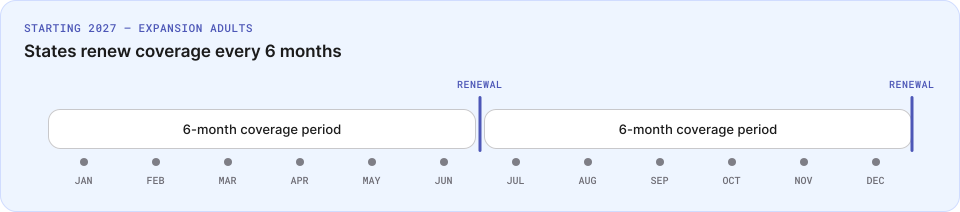
- Renewals every 6 months: A renewal (also called a redetermination) is the state's review of whether a patient still qualifies for Medicaid. States must renew expansion adults every 6 months instead of every 12.
- Less retroactive coverage: Retroactive coverage pays for care a patient got before they applied for Medicaid. For expansion adults, it will reach back 1 month instead of 3.
How do these changes affect eligibility checks?
For expansion adults, providers need to check Medicaid coverage more often.
Previously, states reviewed most Medicaid patients' coverage once a year. That meant a Medicaid eligibility check from months ago was often good enough to verify coverage.
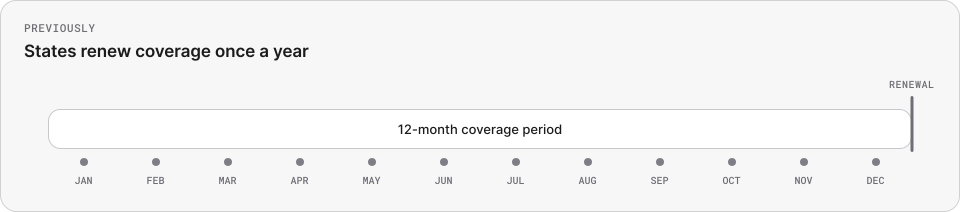
With the OBBBA's changes, an eligibility check for an expansion adult can go out of date within months. Check Medicaid coverage closer to each visit to avoid denied claims and unexpected patient bills.
How often should I run eligibility checks for Medicaid patients?
We recommend you run an eligibility check for Medicaid patients every month and before each visit. Monthly checks catch coverage changes after renewals. Checks before a visit confirm coverage for that date of service.
Monthly eligibility refreshes
You can run a monthly eligibility refresh with real-time eligibility checks or batch eligibility checks. You can run the checks using Stedi's API or the Stedi portal, which supports bulk CSV for batch checks.
If you're new to Stedi, we recommend starting with real-time checks. They're simpler to set up and work well in most use cases.
If you need to check thousands of patients at once, use batch checks. They handle queuing and retries automatically.
For details, see When to use batch eligibility checks. For scheduling tips, see How to optimize monthly eligibility refresh checks.
Eligibility checks before visits
Use a real-time eligibility check to verify Medicaid coverage before a visit.
Do eligibility responses include Medicaid renewal dates?
Sometimes. Stedi uses the HIPAA X12 standard to exchange transactions, including eligibility checks, with payers. The X12 standard for eligibility responses doesn't include a field for a renewal date.
Some state Medicaid agencies include the date anyway. When they do, it's usually in the Real-Time Eligibility Check (270/271) JSON API's subscriber.dates.certification or subscriber.dates.policy.end field. For example:
{
  "subscriber": {
    "dates": {
      "certification": {
        "start": "2026-12-31" // renewal date
      }
    }
  }
}
Other payers put the date in a free-text message on a benefit entry, like plans[].benefits.statuses[].messages. For example:
{
  "plans": [
    {
      "benefits": {
        "statuses": [
          {
            "status": "ACTIVE_COVERAGE",
            "messages": [
              "MEDICAID REDETERMINATION DATE 12/31/26" // renewal date
            ]
          }
        ]
      }
    }
  ]
}
Many Medicaid payers don't return a renewal date at all. When you get one, use it as a reminder to recheck. Some payers keep returning active coverage after the date passes.
What should I do if coverage comes back inactive?
Run an insurance discovery check. Inactive Medicaid coverage doesn't always mean the patient is uninsured. The patient might have other coverage, like a new employer plan.
Insurance discovery checks search for a patient's active coverage across payers using only demographic data like first name, last name, date of birth, state, and (optionally) Social Security number (SSN).
Does the OBBBA change Medicare eligibility checks?
No, not for most Medicare patients.
The OBBBA limits Medicare to U.S. citizens, green card holders, and a few other groups. It also ends coverage for other enrollees, like refugees and asylees, by January 2027.
These changes don't affect how often Medicare coverage changes or how you run Medicare eligibility checks.
Get started with Stedi
To get started with Stedi, sign up for a free sandbox account. It takes less than two minutes. No credit card is required.
Sandbox accounts give you access to mock eligibility checks you can use for testing or integration.
When you're ready, upgrade to production on our pay-as-you-go plan. There are no monthly minimums or setup fees. You only pay for the transactions you use.