Spotlight: Prakash Jayaramaraju @ iMagnum Healthcare
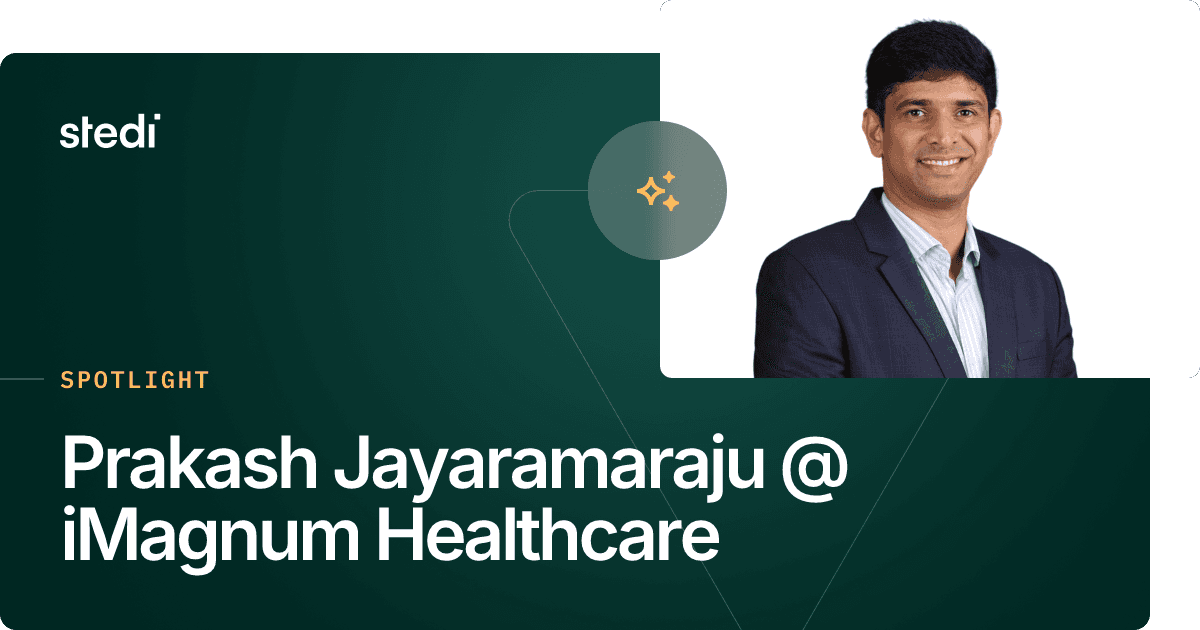
A spotlight is a short-form interview with a leader in health tech. In this spotlight, you'll hear from Prakash Jayaramaraju, CEO of iMagnum Healthcare.
What does iMagnum Healthcare do?
iMagnum is a technology-intensive revenue cycle management company helping physician groups, clinics, rural hospitals, and healthcare organizations improve financial performance while reducing the cost to collect.
We started as a services-led RCM company, but in October 2021 made a deliberate decision to invest heavily in technology and automation. Since then, we have evolved into a technology-intensive RCM organization, combining experienced revenue cycle professionals with automation across eligibility and benefits, prior authorization, coding, denials, provider credentialing, EOB-to-ERA conversion, and healthcare data migration.
One of our most successful engagement models has been AR Rundown. Rather than asking a provider to immediately transition their entire revenue cycle, we can start by taking responsibility for aging or challenging AR, often through a contingency-based model. It gives us an opportunity to demonstrate measurable results and earn the client's trust before expanding the relationship.
In many cases, a successful AR Rundown has become the starting point for a broader partnership and ultimately end-to-end RCM.
At the same time, we don't believe every provider should be forced into the same commercial or delivery model. We remain flexible around what works best for our clients – whether that's contingency-based AR recovery, targeted RCM functions, technology-enabled services, dedicated teams, or full end-to-end RCM.
Our philosophy is simple: technology should not just automate work – it should lower the cost to collect and produce measurable financial outcomes.
How did you end up working in health tech?
I came into healthcare through the operational side of revenue cycle management, where I saw firsthand how much valuable human effort was being consumed by repetitive, fragmented, and highly manual processes.
That eventually led me to a bigger question: instead of continuously adding people to solve RCM problems, what if we redesigned the work itself?
That question became an important part of iMagnum's evolution.
Since 2021, we have increasingly focused on combining deep RCM domain expertise with automation and AI to solve problems that historically required significant manual intervention.
For me, health tech isn't about technology for technology's sake. It's about removing friction from the revenue cycle, reducing administrative burden, and helping providers get appropriately paid for the care they deliver.
How does your role intersect with revenue cycle management (RCM)?
My role sits at the intersection of RCM operations, technology, client strategy, and financial outcomes.
I spend a significant amount of time looking at revenue cycle workflows and asking three questions:
Why does this require human intervention? Can technology perform or accelerate it? And, most importantly, does changing the workflow improve the provider's financial outcome?
That last question is critical.
The future of RCM cannot simply be measured by how many tasks we automate. It needs to be measured by outcomes: lower cost to collect, faster cash acceleration, fewer preventable denials, greater staff productivity, and stronger ROI.
My role is increasingly about connecting those dots – bringing together RCM domain expertise, technology, automation, and human judgment to create operating models where technology handles what it does best and people focus their expertise on the exceptions and decisions where they create the most value.
Ultimately, I believe the best RCM model isn't technology versus people. It's about finding the right combination of technology + human intelligence + measurable outcomes.
What do you think RCM will look like two years from now?
I believe RCM will move from being predominantly labor-driven to increasingly exception-driven.
Automation and AI will handle a much larger portion of routine revenue cycle activity – from eligibility and prior authorization to coding, claim-status workflows, payment processing, denials, and appeals.
Human expertise will absolutely remain critical, but where that expertise is deployed will change. People will increasingly focus on exceptions, complex claims, payer escalation, clinical or coding judgment, and situations where human decision-making creates greater value.
I also believe the bigger transformation will be economic.
Providers will increasingly stop asking only, “How many people are working on my account?” and start asking, “What does it cost me to collect each dollar, and what measurable return am I getting from your technology?”
That changes how RCM partnerships are evaluated.
The winners will not necessarily be the companies with the most automation or the largest workforce. They will be the organizations that can intelligently combine technology with human expertise and demonstrate measurable improvements in cost to collect, cash acceleration, denial prevention, productivity, and ROI.
That is also the direction we're building toward at iMagnum: technology-first where it makes sense, human-in-the-loop where judgment matters, flexible commercial models, and an obsessive focus on measurable financial outcomes for our clients.