Why claims go missing and how to find them
You're a provider. You submitted a claim to a patient's payer weeks ago. You haven't heard anything back.
You have a copy of the patient's insurance card. It has a Cigna logo and lists a support number. You call it.
It's not Cigna. It's a third-party administrator (TPA) that runs the patient's employer-sponsored health plan.
"We don't have that claim in our records. Try Cigna – we use their network."
You call Cigna. They don't see it either. So you reach out to your healthcare clearinghouse – the one you used to submit the claim. They confirm it went out. That's all they can say.
The claim exists. You sent it. But no one can tell you where it is.
—
Most claims don't go straight from provider to payer. They may pass through several systems first. Any one of them can drop or lose the claim.
If you're a provider or biller trying to track down a claim that seems to have vanished, this guide is for you. It covers the common reasons a claim might get lost and what to do when it happens.
How a claim reaches the payer
Most providers submit claims through billing software – a revenue cycle management (RCM) tool or an electronic health record (EHR) system with billing built in.
The software hands the claim to a healthcare clearinghouse, such as Stedi, which connects to payers on the provider's behalf. The clearinghouse checks the claim for errors, then routes it to the right payer. This path from the clearinghouse to the payer is called payer routing.
Payer routing isn't always direct. Some payers require every claim to arrive through a designated clearinghouse. In other cases, a clearinghouse can't reach the payer directly and relays the claim through an intermediary clearinghouse – sometimes through several.

Claim acknowledgments
Ideally, each entity that handles the claim – a clearinghouse or a payer – also sends a claim acknowledgment back to the provider's original clearinghouse. The acknowledgment tells you whether the claim was forwarded, rejected, or accepted for adjudication (ruling on payment) by the payer.
When a clearinghouse or payer doesn't return acknowledgments, the claim becomes hard to track. It isn't usually gone. It was rejected, stalled, or misrouted somewhere in the chain, and nothing came back to tell you which.
Acknowledgments are just one way to track a claim's status. To see how they fit in with other claims transactions, read our How claims transactions fit together blog post.
Common causes of a lost claim
Your clearinghouse rejected your claim without acknowledgment
Before routing your claim, most clearinghouses run validations, called edits, to check for errors. For example, edits may check for missing fields or invalid procedure codes.
Many of these edits mirror the checks that payers perform on claims. Payers often take days to reject a claim, which slows down payment. Clearinghouse edits catch these mistakes earlier – before they reach the payer. You can fix the claim, resubmit, and get paid faster.
Most clearinghouses have edits and will reject claims that fail them. But some clearinghouses don't return acknowledgments. Without an acknowledgment, you or your billing software may never learn that the clearinghouse rejected the claim at all – so from your side, it looks like the claim simply vanished.
A good clearinghouse won't just reject a claim quickly – it'll tell you why, through a claim acknowledgment or error message.
Resolution tip
Submit claims through a clearinghouse that returns claim acknowledgments and errors. Stedi returns claim-edit errors and acknowledgments that your software vendor can surface to you. You can also check a claim's status directly in the Stedi portal's claims view.
Your clearinghouse didn't forward your claim
A claim can pass your clearinghouse's checks and still stall before it reaches the payer. In most cases, this is caused by an issue with the clearinghouse's own infrastructure or a connection downstream of the clearinghouse.
If your clearinghouse doesn't return acknowledgments or tell you about downstream issues, you may not know there's a problem at all.
A good clearinghouse will return an acknowledgment when it forwards your claim – and pass on acknowledgments returned by any downstream clearinghouses or payers. It will also proactively notify you of outages or issues.
Resolution tip
Submit claims through a clearinghouse that returns claim acknowledgments and alerts you when there's an outage.
Where possible, Stedi uses redundant payer routes to minimize the impact of intermediary clearinghouse outages. In many cases, our customers don't notice an outage.
For widespread outages, we reach out to the payer or the intermediary clearinghouse – and we notify affected customers in Slack or Teams.
The claim went to the wrong payer
Some payers have different IDs for different plans or claim types. Others are part of a network of payers that share similar names. For example, Blue Cross Blue Shield (BCBS) isn't one payer. It's a collection of 30+ separate state and regional payers. Each has its own payer ID. In these cases, it's easy to get the payer IDs mixed up.
If you submit a claim to the wrong payer, the payer may reject it. If the payer doesn't send a claim acknowledgment, you may not know it went to the wrong place.
Resolution tip
Before submitting a claim, run an eligibility check using the patient's first name, last name, member ID, and date of birth. The response can confirm the patient is on file with the payer.
The payer rejected the claim without acknowledgment
Even when a claim reaches the payer, the payer can reject or drop it without an acknowledgment making it back to you.
Payers are supposed to return an acknowledgment when they accept or reject a claim, but that response doesn't always propagate back through every clearinghouse in the chain.
The result is the same as the others: you're left with no status.
Resolution tip
Run a claim status check
If the payer supports claim status checks and you haven't received a claim acknowledgment from the payer within 2-3 days of claim submission, run a claim status check to see if the claim is in adjudication with the payer.
If the check comes back with no matching claim, run an eligibility check to confirm that the patient's demographic information matches what's on file with the payer. If it matches, the payer likely has not received the claim. Follow up with your clearinghouse.
Contact your clearinghouse
Not every payer supports real-time claim status checks. Even when they do, a check can error out or come back with no match.
In these cases, check whether the payer ever returned a 277CA acknowledgment. If not, the claim most likely never reached them – follow up with your clearinghouse to track it down.
A claim stuck in this state also puts you at risk of missing timely filing deadlines. Don't wait for an Electronic Remittance Advice (ERA). If the claim didn't reach the payer, it won't show up in an ERA.
If you use Stedi as your clearinghouse, we can help you track down claims in these cases. We offer real-time support over Slack, Microsoft Teams, and email. Our average response time is less than 10 minutes during business hours.
Third-party administrators (TPAs)
Many employer-sponsored health plans aren't run directly by a payer like Cigna or Aetna. Instead, the employer or union pays for care with its own money and hires a third-party administrator (TPA) to run the plan.
A TPA-run plan still needs a provider network – the doctors, hospitals, and clinics under contract, and the rates they've agreed to accept. Many TPAs lease that network from a payer. Cigna, UnitedHealthcare, and Aetna all lease their networks this way.
In these cases, it's not always apparent whether a patient's health plan is run by a payer or a TPA. The member ID card shows the payer's logo, even for a TPA-run plan. The payer ID on the card may belong to the TPA or the payer.
For most plans, the difference occurs after the claim reaches the payer. The payer, such as Cigna, prices the claim against its contracted rates, then forwards it to the TPA. For other plans, the claim goes straight to the TPA, which sends it to the payer for pricing.
Either way, the TPA adjudicates the claim and pays the provider from the plan's funds. The TPA acts as the actual payer.
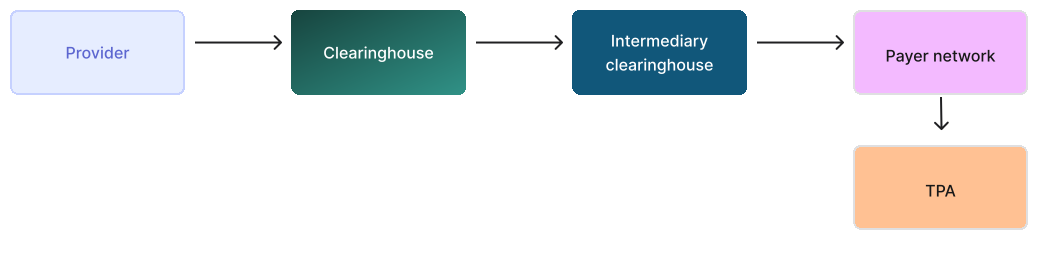
In addition to processing claims, TPAs typically handle support. If you use the support contact information listed on the patient's member ID card, you'll likely get in touch with the TPA.
However, TPAs aren't always in a position to help. If something happens to the claim before it reaches the TPA – say it was rejected by the payer – the TPA won't know the claim exists. In those cases, they may refer you to your clearinghouse, the payer, or maybe even this blog post.
Get started with Stedi
Most lost claims come down to visibility. Stedi gives you that visibility through every part of the lifecycle – from submission and validation to payment and remittance.
Stedi returns claim acknowledgments and errors at every step, so you always know whether a claim was forwarded, rejected, or accepted – and why. If a claim still goes missing, we help you track it down.
Sign up for free to get started. It takes less than two minutes. No credit card is required.