

Submit claims
You can submit professional, dental, and institutional claims through the Stedi portal:
- Electronic claims: You submit through the Stedi portal. Stedi submits your claim to the payer electronically.
- Paper claims: You submit through the Stedi portal with the receiver ID set to
PAPER(Print and Mail - All Payers). Stedi prints and mails the claim to the payer on your behalf.
Electronic claims
You can submit professional claims through our interactive claim form or by uploading X12 EDI claim data. There's no interactive claim form for dental and institutional claims, but you can submit them by uploading X12 EDI claim data.
Claim form (professional only)
The CMS-1500 form in the portal only supports submitting claims to the patient's primary health plan, though you can include information about secondary or tertiary payers if required. To submit claims directly to secondary or tertiary payers, use the portal's X12 EDI upload functionality instead.
To submit a professional claim: Go to the claims view, click Submit claim, and select CMS-1500 form from the dropdown.
The submission form is based on the CMS-1500 Claim Form.
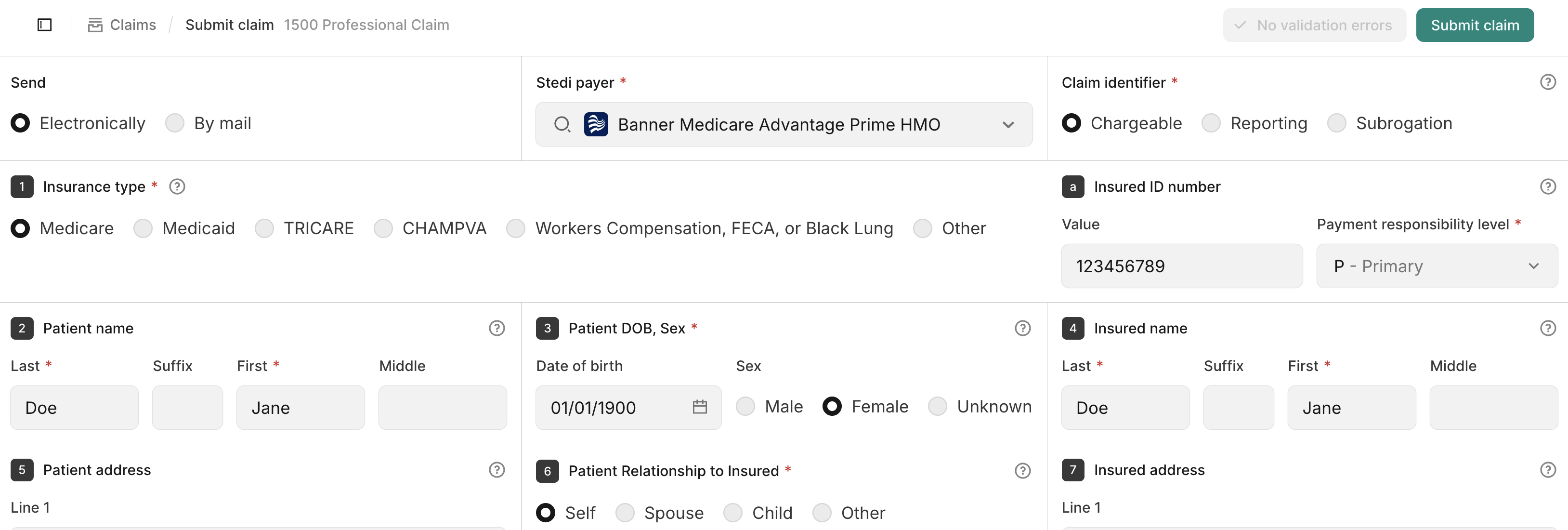
Enter the required information for your professional claim. Notably:
| Form section | Instructions and Notes |
|---|---|
| Send | Select whether you want to send the claim Electronically or By mail.
|
| Stedi payer | Select the payer from the Stedi payer dropdown list. Start typing to filter the list. When you select a Medicare or Medicaid payer, Stedi automatically sets Box 1 (Insurance Type) to match. You can change the value in Box 1 if needed. |
| Patient account number | We strongly recommend submitting a unique value in Box 26 (Patient account number). We recommend an identifier that's more complex than a simple sequential number and hard to guess. The payer returns this value in related transactions, such as the 277CA and 835 Electronic Remittance Advice (ERA), so you can correlate responses and real-time claim status checks with the original claim.
|
| Line item control numbers | The line item control number is an identifier for each service line in Box 24 (Service lines) that you can use to correlate the original claim with the 835 ERA.
|
| Attachments | Submit claim-level attachments in Box 19b (Claim attachments) and service-line attachments in Box 24 (Service lines). Note that you can't add attachments to claims that were already submitted through the portal. To include attachments for those, resubmit the claim with the attachments.
|
| Secondary or tertiary or payer details | To submit a coordination of benefits (COB) claim, enter the patient's other health plans in Box 9 (Other insured). Click + Add other insured once for each additional plan. Each other insured card includes:
|
Stedi checks for errors as you complete the form, including issues that can cause the claim to fail Stedi's claim edits. When you're finished, click Submit claim. Stedi doesn't submit the claim until you fix all errors. After submission, Stedi opens the claim's timeline, where you can follow its progress.
Later, you'll also see related claim responses, such as 277CA claim acknowledgments and 835 Electronic Remittance Advice (ERAs).
X12 EDI upload
You can submit professional, dental, and institutional claims through the Stedi portal in X12 EDI format. Claim data must adhere to the following X12 HIPAA claim specifications:
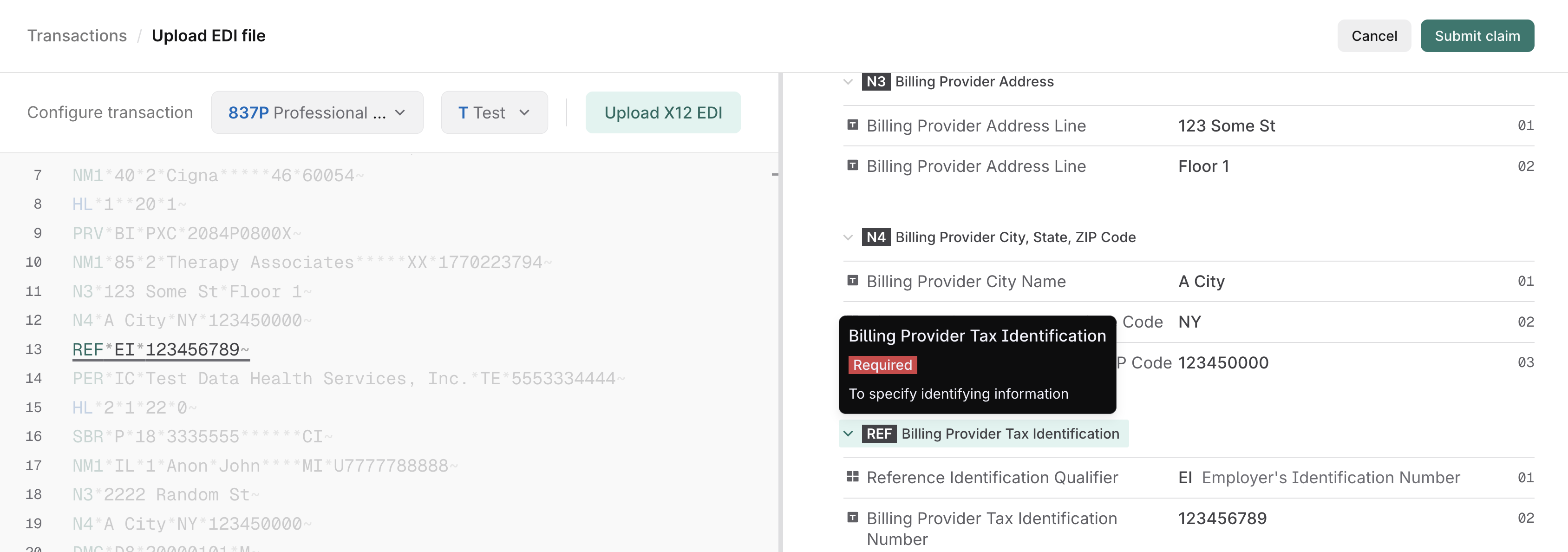
Raw X12 uploads use your account's Stedi SFTP connection. If your account doesn't have one, contact Stedi support to enable raw X12 uploads.
To manually submit an X12 EDI claim:
-
Go to the claims view.
-
Click Submit claim and select Upload raw X12 file.
-
Do one of the following:
- Click Upload X12 EDI and select an existing
.edifile. - Select the transaction type and then paste the X12 EDI content into the text area.
You can submit multiple claims in a single file, as long as all claims are 837s of the same type and X12 version. Visit Bulk claims for details.
- Click Upload X12 EDI and select an existing
-
Set
ISA15(Interchange Usage Indicator) toP(Production Data). Stedi rejects claims withISA15set toT. To send test claims, visit Test claims workflow. -
Fix any X12 EDI validation errors that appear after adding the claim content. Stedi highlights errors in red and displays the specification for the claim type you selected on the right side of the screen to make it easier to identify and fix issues.
These validations ensure your claim data conforms to the HIPAA specification. Stedi runs additional claim edits on your claim data after submission.
-
Click Submit claim.
Stedi processes the claim and runs claim edits to identify errors that could lead to a payer rejection. If a claim fails one of Stedi's edits, you'll receive a 277CA claim acknowledgment from Stedi rejecting the claim immediately after submission. This can happen even when the X12 EDI editor showed no errors before submission.
If the claim passes all of Stedi's edits, Stedi submits it to the payer. It will appear on the claims view within a few minutes.
Bulk claims
You can submit multiple claims in a single X12 EDI file, as long as they are all the same claim type (professional, institutional, or dental) and X12 version. You can submit multiple claims in the same 837 transaction by including multiple instances of the following loops:
Loop 2000A(Billing provider)Loop 2000B(Subscriber)Loop 2300(Claim Information) - You can submit up to 1,000 claim loops in each 837 transaction
After submission, Stedi separates your bulk 837 transaction into individual claims and sends each claim separately to the payer. This includes multiple claims going to the same payer - all claims within a bulk submission are sent individually to maintain consistency.
The following example would produce 12 separate claims (2 x 3 x 2 = 12), each shown individually on the claims view:
- 837 transaction contains information for two billing providers (2x
Loop 2000A) - Each billing provider has three subscribers (3x
Loop 2000B) - Each subscriber has two claims (2x
Loop 2300)
Then, you'll typically receive separate 277CA claim acknowledgments for each claim. Each claim will also receive its own test ERA from Stedi's test clearinghouse if the payer was STEDITEST.
Secondary and tertiary claims
To submit a claim to a secondary or tertiary payer in X12 EDI format, set the following elements in the 837 transaction. Get the adjudication details from the prior payers' 835 Electronic Remittance Advice (ERAs).
Subscriber and claim
| Element | What to include |
|---|---|
Loop 2000B SBR01 (Payer Responsibility Sequence Number Code) | Set to S when submitting to the secondary payer or T when submitting to the tertiary payer. |
Loop 2300 CLM01 (Patient Control Number) | Generate a new, unique Patient Control Number (PCN) for each secondary or tertiary claim. Don't reuse the PCN from the primary claim. |
Prior payers
Include one Loop 2320 (Other Subscriber Information) for each prior payer, with the following information:
| Element | What to include |
|---|---|
Loop 2320 SBR01 (Payer Responsibility Sequence Number Code) | The prior payer's position in the payer order, such as P for the primary payer. |
Loop 2320 CAS (Claim Level Adjustments) | Include if the prior payer made adjustments at the claim level. The codes and amounts must come from the prior payer's ERA. |
Loop 2320 AMT02 (Payer Paid Amount), when AMT01 is D | The total amount the prior payer paid on the claim. |
Loop 2320 MIA (Inpatient Adjudication Information) | Institutional claims only. Include if Medicare was a prior payer and reported inpatient adjudication information on the ERA. |
Loop 2320 MOA (Outpatient Adjudication Information) | Include if Medicare was a prior payer and reported outpatient adjudication information on the ERA. |
Loop 2330B NM109 (Other Payer Primary Identifier) | The prior payer's identifier. |
Loop 2330B DTP03 (Adjudication or Payment Date), when DTP01 is 573 | The date the prior payer adjudicated or paid the claim. Include this if you don't include Loop 2430 for this payer. |
Service lines
When the prior payers reported line-level adjudication information, include one Loop 2430 (Line Adjudication Information) for each prior payer within each service line, with the following information:
| Element | What to include |
|---|---|
SVD01 (Other Payer Primary Identifier) | The prior payer's identifier. This value must match Loop 2330B NM109 for the same payer. |
SVD02 (Service Line Paid Amount) | The total amount the prior payer paid on the service line. |
SVD03-01 (Product or Service ID Qualifier) and SVD03-02 (Procedure Code) | The adjudicated procedure code for the service line and its qualifier. |
SVD03-03 through SVD03-06 (Procedure Modifier) | The adjudicated procedure modifiers for the service line, if any. |
SVD04 (Service Line Revenue Code) | Institutional claims only. The revenue code for the service line. This element is required for institutional claims. |
SVD05 (Paid Service Unit Count) | The number of paid units for the service line. If the ERA doesn't include paid units, use the original billed units. |
CAS (Line Adjustment) | The prior payer's adjustments to the service line, from the ERA. |
DTP03 (Adjudication or Payment Date), when DTP01 is 573 | The date the prior payer adjudicated or paid the service line. This element is required in each Loop 2430. |
AMT02 (Remaining Patient Liability), when AMT01 is EAF | The amount of the service line the patient is responsible for paying. |
Paper claims
Some payers require you to submit claims on paper rather than electronically. Instead of mailing these claims yourself, you can send the claim information to Stedi using an electronic submission workflow with the receiver ID set to PAPER (Print and Mail - All Payers). Stedi then handles printing and mailing the claim to the designated payer on your behalf.
You can submit the following claim types as paper claims:
- Professional: Through the CMS-1500 form or X12 EDI upload
- Dental: Through X12 EDI upload
- Institutional: Through X12 EDI upload
How it works
Here's the end-to-end paper claims process:
Submit your claim through the CMS-1500 form or X12 EDI upload with the receiver ID set to PAPER and the payer's mailing address. You can also include unsolicited claim attachments, which must be PDF files.
Stedi validates the claim and any attachments before sending them to our print-and-mail partner for processing.
You can monitor progress through the claims view. The claim timeline for paper claims shows its print status as the claim moves through staged, queued, printed, and mailed stages. You receive a 277CA claim acknowledgment for every successful submission, and another 277CA when the claim is mailed or when the claim fails.
Once available, you can download the PDF proof showing exactly what was mailed to the payer.
The payer receives the printed claim package and processes it. They typically mail an Explanation of Payment (EOP) for commercial payers or Standard Paper Remittance (SPR) for Medicare and Medicaid back to the provider.
Limitations
Paper claims have the following limitations:
- No test mode: You can submit test paper claims through Stedi, but Stedi doesn't generate test lifecycle 277CAs, such as a 277CA indicating the test claim was mailed.
- No preview before submission: You can't preview the rendered claim form before submission. Once available, you can download a PDF proof from the portal.
- ERAs typically unavailable: Payers that require paper claim submission usually don't support Electronic Remittance Advice (ERAs). Instead, they typically mail an Explanation of Payment (EOP) for commercial payers or Standard Paper Remittance (SPR) for Medicare and Medicaid back to the provider.
Transaction enrollment
Transaction enrollment isn't required for paper claim submission. However, you may still need enrollment for Electronic Remittance Advice (ERAs) if the payer supports them.
Note that payers that require paper claim submission usually don't support ERAs:
- HIPAA covered entity health plans are required to send ERAs electronically.
- Other health plans may use different formats and communication channels for both claim submissions and remittances.
Submit paper claims
You can submit paper claims through the CMS-1500 form or X12 EDI upload in the Stedi portal. All submission methods require you to set the receiver ID to PAPER and include the payer's mailing address.
Paper receiver ID
Stedi uses a special payer ID to route claim submissions for printing and mailing: PAPER (Print and Mail - All Payers). You must submit this as the receiver ID in the claim submission.
For paper claims, it's the receiver ID that determines whether a claim is printed and mailed or sent electronically:
| Name | Location | Description |
|---|---|---|
| Receiver ID |
| Controls the delivery method. |
| Payer ID |
| Identifies the destination payer. |
When you set the receiver ID to PAPER (or select By mail in the CMS-1500 form), Stedi bypasses the traditional electronic submission flow and uses the mail-to payer name and mailing address to print and mail a paper claim to the payer.
You'll still set the payer ID to the destination payer's ID or alias, if available in the Stedi Payer Network. However, you can also set the payer ID to PAPER when you need to send paper claims to payers outside of the electronic network.
For example, you can set the receiver ID to PAPER while keeping the payer ID as CIGNA. This, along with Cigna's mailing address, tells Stedi to print and mail the claim to Cigna.
CMS-1500 form UI
You can submit professional paper claims through the CMS-1500 form. Within the form, configure these paper-specific settings:
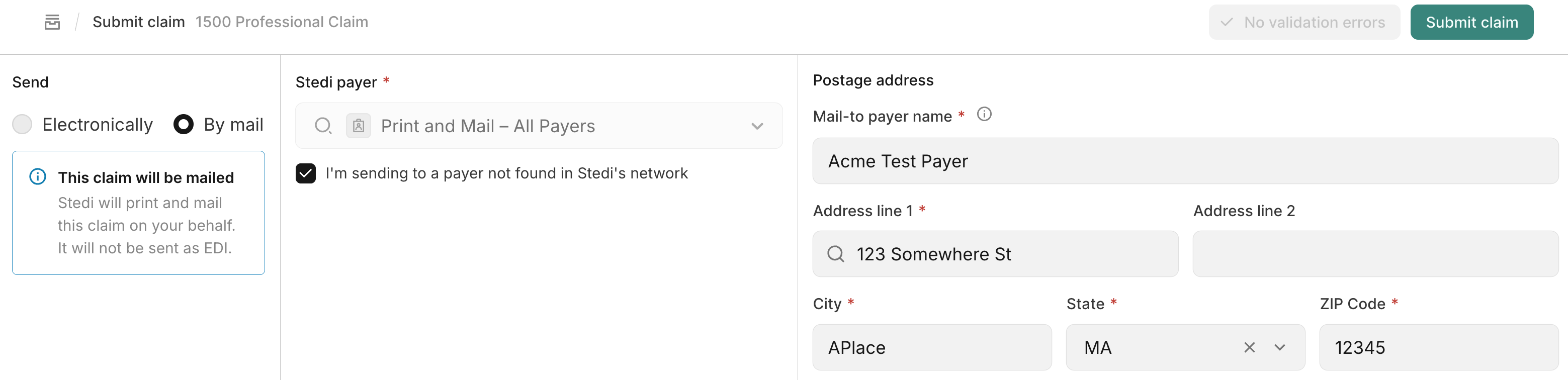
-
In the Send section, select By mail. This shows the Postage address section for the mail-to payer name and address.
-
In the Stedi payer dropdown:
- If the payer exists in Stedi's Payer Network, select it from the dropdown.
- If the payer is not in the network, check I'm sending to a payer not found in Stedi's network. Stedi automatically populates the dropdown with the Print and Mail - All Payers option.
-
In the Postage address section:
- Update the Mail-to payer name if necessary. This becomes the addressee on the physical envelope.
- Complete the address fields (Address line 1, Address line 2, City, State, and ZIP Code) with the complete mailing address where Stedi sends the claim.
-
For attachments:
- In the Claim attachments section, choose a Report type.
- Attach a PDF file to the submission. Paper claims don't support other file types. Stedi prints the attachment in color and mails it along with the claim to the payer.
After you submit the claim, Stedi uses the paper payer ID and the mailing address you provided to route the claim for printing and mailing.
X12 EDI upload
You can submit professional paper claims through X12 EDI upload. Construct an X12 EDI claim as you normally do. Then, add the following information.
| Location | Elements |
|---|---|
Loop 1000B (Receiver Name) | Set the following paper-specific elements:
|
Loop 2010BB (Payer Name) | Set the following paper-specific elements:
|
After you submit the claim, Stedi uses the receiver ID set to PAPER, the payer ID, and the mailing address you provided to route the claim for printing and mailing.
The following example shows a professional paper claim to a payer in Stedi's Payer Network. It uses:
- The paper payer ID
PAPERinLoop 1000B(Receiver Name)NM109. - Cigna's payer ID from the Stedi Payer Network in
Loop 2010BB(Payer Name)NM109.
ISA...~
GS...~
ST*837*0001*005010X222A1~
...

NM1*40*2*CIGNA*****46*PAPER~                             // Paper payer ID
NM1*PR*2*CIGNA*****PI*62308~                             // Name and payer ID
N3*123 Example Street*STE 100~                           // Mailing address
N4*Mountain View*CA*940433706~

...
SE...~
GE...~
IEA...~
The following example shows a submission for a payer outside Stedi's Payer Network. It uses:
- The paper payer ID
PAPERinLoop 1000B(Receiver Name)NM109. - The paper payer ID
PAPERinLoop 2010BB(Payer Name)NM109.
ISA...~
GS...~
ST*837*0001*005010X222A1~
...

NM1*40*2*ACME Employer LLC*****46*PAPER~ // Paper payer ID
NM1*PR*2*ACME Employer LLC*****PI*PAPER~ // Name and paper payer ID
N3*987 Example Street*STE 200~           // Mailing address
N4*Philadelphia*PA*19192~

...
SE...~
GE...~
IEA...~
Secondary and tertiary paper claims
When you submit a paper claim to a secondary or tertiary payer, include the prior payers' adjudication information in the claim, the same way as for an electronic claim.
In X12 EDI, line adjudication information is in Loop 2430 (Line Adjudication Information).
When a service line includes the prior payer's line adjudication information, Stedi's print-and-mail partner prints supporting Explanation of Benefits (EOB) pages with the prior payers' adjudication details and mails them with the claim form.
Stedi charges for supporting EOB pages at the same rate as additional claim pages. For current rates, visit Stedi pricing.
Track print status
As a paper claim moves through the print-and-mail workflow, it goes through the following statuses:
| Stage | Meaning |
|---|---|
| Staged | Stedi accepted the claim for mailing. |
| Queued | The print-and-mail partner queued the claim for printing. |
| Printed | The print-and-mail partner printed the claim form and any attachments. |
| Mailed | The print-and-mail partner mailed the claim package to the payer. |
| Failed | The claim wasn't mailed. The timeline row shows the reason. |
Stedi mails claim packages within the US using USPS First Class postage. USPS estimates delivery in 1 to 5 days.
The envelope has Stedi's return address. If USPS returns a mailed claim as undeliverable, Stedi sends you a 277CA that rejects the claim.
The latest print status appears in several locations:
-
Claims view: Shows the status as an icon in the Status column. You can filter by print status.
-
Claim details panel and claim timeline: The Claim details panel displays the current status in the Print status row. The claim timeline shows the progression through each stage.
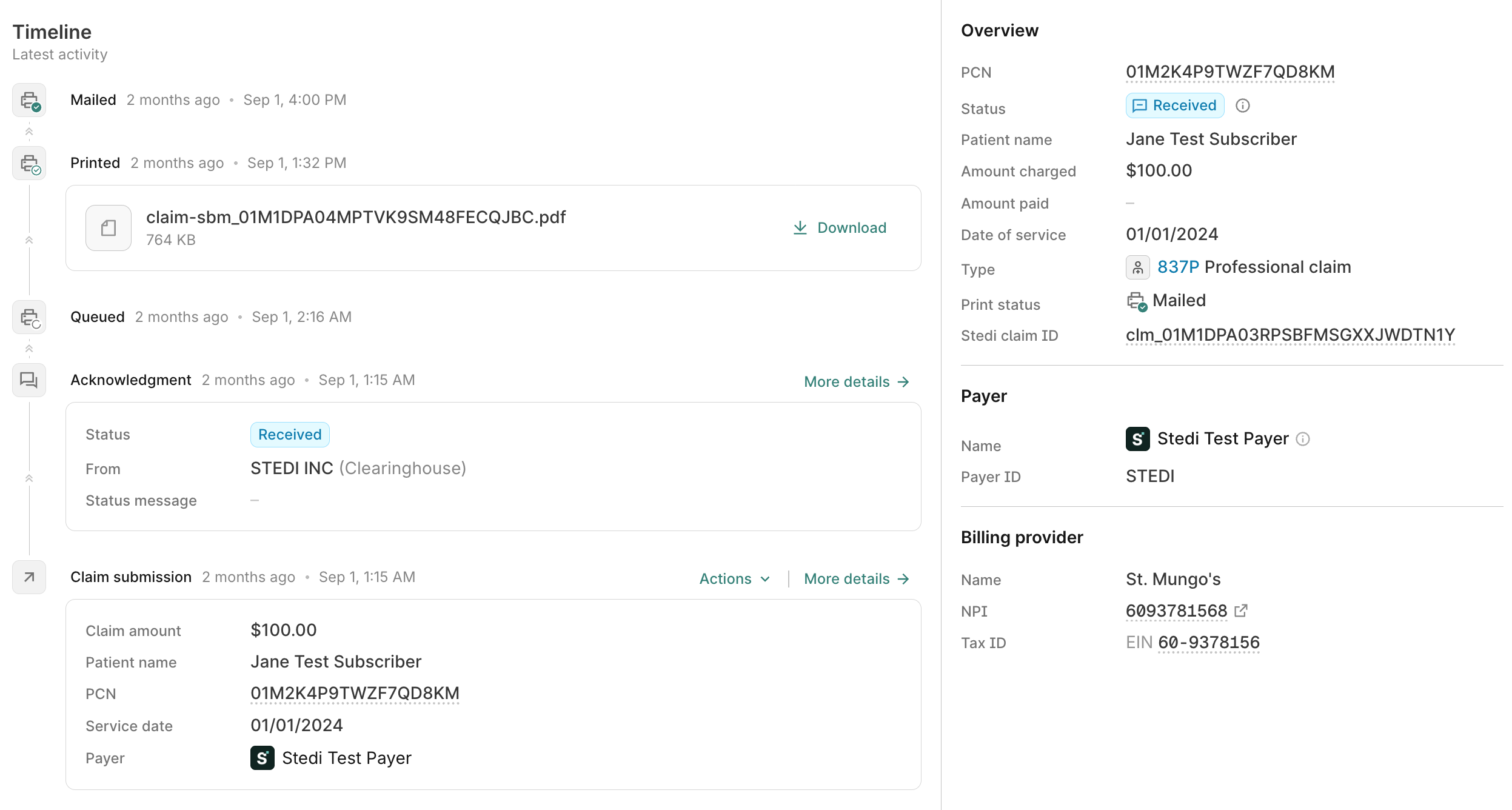
You receive 277CA claim acknowledgments when the claim reaches the Staged, Mailed, or Failed status.
Printed claim forms
Stedi prints professional claims on the red CMS-1500 claim form, which uses optical character recognition (OCR) dropout ink. Medicare contractors and many Medicaid programs only accept claims on the red form.
Stedi prints each claim as you submit it, including corrected and void claims. When you submit a corrected (7) or void (8) claim, the printed form shows the resubmission code and the original claim's reference number in Box 22 (Resubmission Code and Original Ref. No.).
Paper claim responses
When you submit a paper claim, you receive different types of responses than you do for electronic claims. This section explains what to expect.
Receipt confirmation
Immediately after submission, Stedi opens the claim's timeline if you used the CMS-1500 form. If you uploaded an X12 file, Stedi returns you to the claims view.
277CA claim acknowledgments
Stedi generates a 277CA claim acknowledgment with status A1/20 when it accepts a claim for processing and marks the claim's status as Staged. After that, Stedi sends a 277CA when the claim reaches Mailed status or Failed status. Visit Track print status for details on all available statuses.
-
Mailed: When the claim is successfully mailed to the payer, you receive a 277CA with status
A0/16(Accepted). The free-form message text states: "The claim has been mailed to the payer. Further updates for the claim may become available via mail." -
Failed: When the payer address fails validation and the claim is not mailed, you receive a 277CA with status
A7/126(Failed). The free-form message text states: "The claim was not mailed due to a validation error of the payer address provided. Please check the provided payer address (2010BB N3/N4) and resubmit."
You won't receive electronic 277CAs from the payer the way you do for an electronic claim submission. Instead, payers may send printed acknowledgments through the mail.
Explanation of Payment (EOP) and Standard Paper Remittance (SPR)
Payers that require paper claim submission usually don't support Electronic Remittance Advice (ERAs). Instead, they typically mail an Explanation of Payment (EOP) for commercial payers or Standard Paper Remittance (SPR) for Medicare and Medicaid back to the provider.
This means you won't receive 835 ERAs through Stedi for paper claims. You'll receive paper EOPs or SPRs by mail from the payer.
PDF proof of mailing
After the print-and-mail partner produces the claim proof, Stedi makes a PDF available in the Stedi portal. The proof represents the printed claim package, including the printed form and any associated attachment pages.
You can download the PDF proof from two locations in the Stedi portal:
-
Claim timeline: Click Download on the Printed row in the claim's timeline.
-
Claim details page: Click Download printed claim on the claim details page.
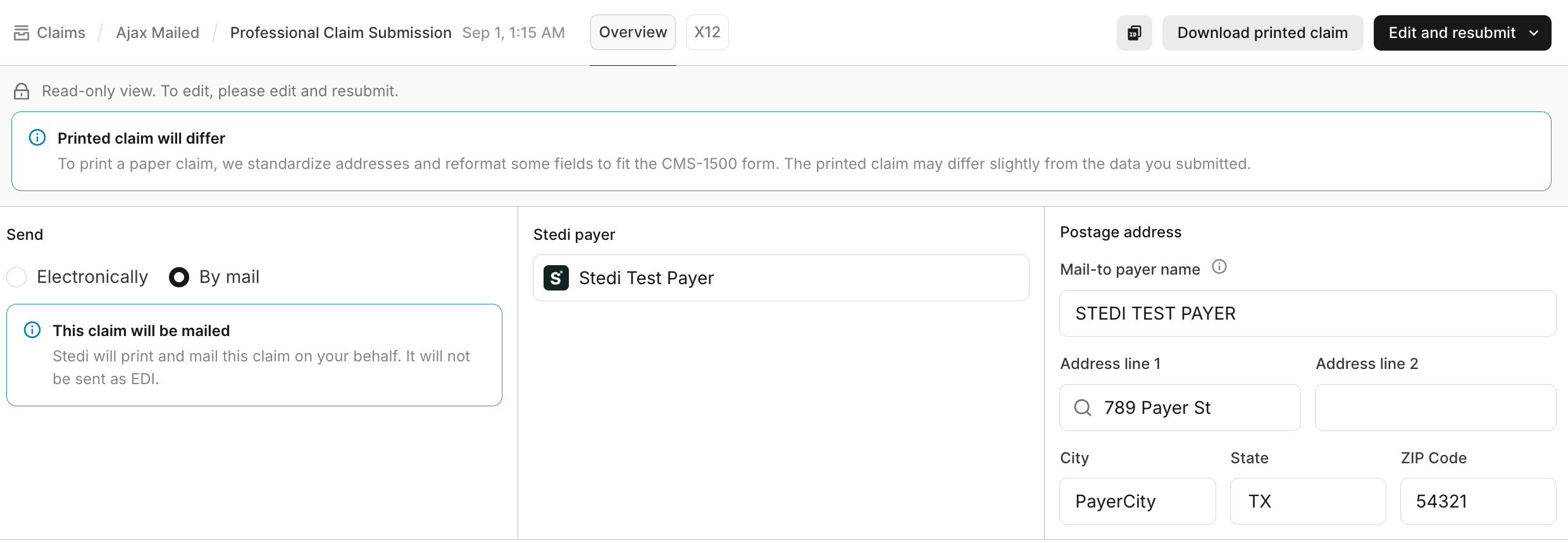
The PDF isn't available immediately at claim submission. You can download the proof only after the print-and-mail partner has printed the claim.
To fit the printed form, Stedi standardizes addresses and reformats some fields. The printed claim can differ slightly from the data you submitted. The claim details page shows a note when this happens.
Best practices
Follow these best practices when submitting paper claims:
- Monitor for 277CA acknowledgments: Watch for the 277CA indicating either successful mailing or failure. You can track additional status updates (staged, queued, and printed) in the Stedi portal.
- Treat mailed 277CA as confirmation: Use the mailed 277CA as confirmation that the print-and-mail partner sent the package to the payer.
- Investigate failures promptly: If you receive a failed acknowledgment, review and correct the payer address, then resubmit. If you don't, the claim won't be mailed to the payer.
- Keep PDF proofs: Download and retain the PDF proof from the Stedi portal for audits, appeals, and payer follow-up.
Download CMS-1500 PDF
Stedi automatically generates a PDF CMS-1500 claim form for submitted professional claims.
You can download a PDF version of professional claims in the CMS-1500 format from the claim's timeline or from a claim submission.
You can download the PDF with or without the CMS-1500 form background. The National Uniform Claim Committee (NUCC) and CMS provide exact specifications for blank CMS-1500 forms, including paper size and ink color. Many provider offices use these pre-printed forms, and their Practice Management System (PMS) applications print claim data onto them. Generating PDFs with no background lets you print the claim data directly onto official pre-printed forms.
From the timeline view
- From the claims view, click a professional claim to open its timeline.
- On the claim submission card, click Actions > Download CMS-1500 claim PDF.
- Click With CMS-1500 form background or Without CMS-1500 form background. The PDF downloads to your computer.
From a claim submission
- From the claims view, click a professional claim to open its timeline.
- Click the claim submission card to open its details.
- Click Download CMS-1500 claim PDF.
- Choose whether to Include CMS-1500 form background. Stedi selects this option by default.
- Click Confirm download. The PDF downloads to your computer.
Payers have strict requirements for submitted CMS-1500 claim forms. If you plan to send generated PDFs to payers or retain them for your records, we strongly recommend visiting CMS-1500 Claim Form PDF for information about the correct printer settings for generated PDFs and general best practices.