6 ways BPOs and RCM services companies can scale with Stedi
To get billing right at scale, many providers turn to business process outsourcing (BPO) organizations to run their revenue cycle management (RCM) for them.
BPOs can help providers do things like check patients' insurance benefits, follow up on claims, and handle collections. And because a BPO serves many providers, it can operate at a scale most practices can't match.
The problem is that many BPOs still rely on tools built for single practices. For example, a BPO may verify insurance by logging into separate payer portals or eligibility tools for every provider. Those manual workflows often become a bottleneck as the BPO adds more clients.
Stedi is a programmable healthcare clearinghouse. Behind the scenes, Stedi uses standardized HIPAA X12 transactions, which work the same way with every payer. You can build one workflow with Stedi and scale it across thousands of providers and payers.
And you don't have to replace your clients' existing systems. You can run Stedi's insurance discovery and eligibility checks alongside a client's Electronic Health Record (EHR) platform or clearinghouse.
If you're a BPO or RCM services company looking to scale, here are 6 ways Stedi can help.
1. Reach thousands of payers from the Stedi portal
Most BPOs work across a mix of payers. Each payer's portal works differently. Any operating procedure you build has to accommodate those differences.
The Stedi portal lets you connect to 3,500+ payers in the Stedi Payer Network – virtually every payer that processes electronic transactions – in one place.
You can use the portal to run insurance discovery checks, check eligibility, submit professional claims, run claim status checks, and track ERAs.
Eligibility and claim status checks run in real time. You get an answer in seconds, instead of calling the payer and waiting.
You don't need a separate procedure for each payer. You build one procedure that works across every payer.
The portal also includes Stedi Agent, an AI assistant. Your team can use the Stedi Agent to recover failed eligibility checks and find missing coverage or get payer IDs from uploaded photos of member ID cards.
2. Find missing insurance coverage with insurance discovery
As a BPO, you rarely control the data you're given. If you need to verify insurance before submitting a claim, you work with whatever the client captured at intake.
Mistakes in intake data are common: a mistyped member ID, the wrong payer, a blurry photo of an insurance card. Payer portals can't help here. You may not even know which payer to ask.
Stedi's insurance discovery check finds a patient's active coverage from basic details like the patient's name, date of birth, state, and ZIP code. You don't need the payer or the member ID.
Most insurance discovery tools find coverage on 15-30% of accounts. Stedi finds coverage on 40-60% of those same accounts.
When a Stedi insurance discovery check finds coverage, you get the same information you'd get from an eligibility check, including the payer's name as well as the patient's member ID and benefits.
You can run insurance discovery checks in the Stedi portal or through the Insurance Discovery API.

3. Re-check whole patient panels with batch eligibility checks
Many forms of healthcare, like dialysis or physical therapy, are recurring. Coverage can change between visits, and each visit can use up part of what the plan allows, like a visit limit or a dollar maximum. Clients often ask their BPO to confirm that next week's or next month's patients still have coverage. These bulk periodic checks are called eligibility refreshes.
New clients bring the same need. Checking a provider's whole patient panel at onboarding surfaces stale coverage before it turns into denied claims.
Batch eligibility checks cover an entire panel – or part of one – at once. You can run batch checks in the Stedi portal by uploading a CSV, or send up to 10,000 checks in a single Batch Eligibility Check API request.
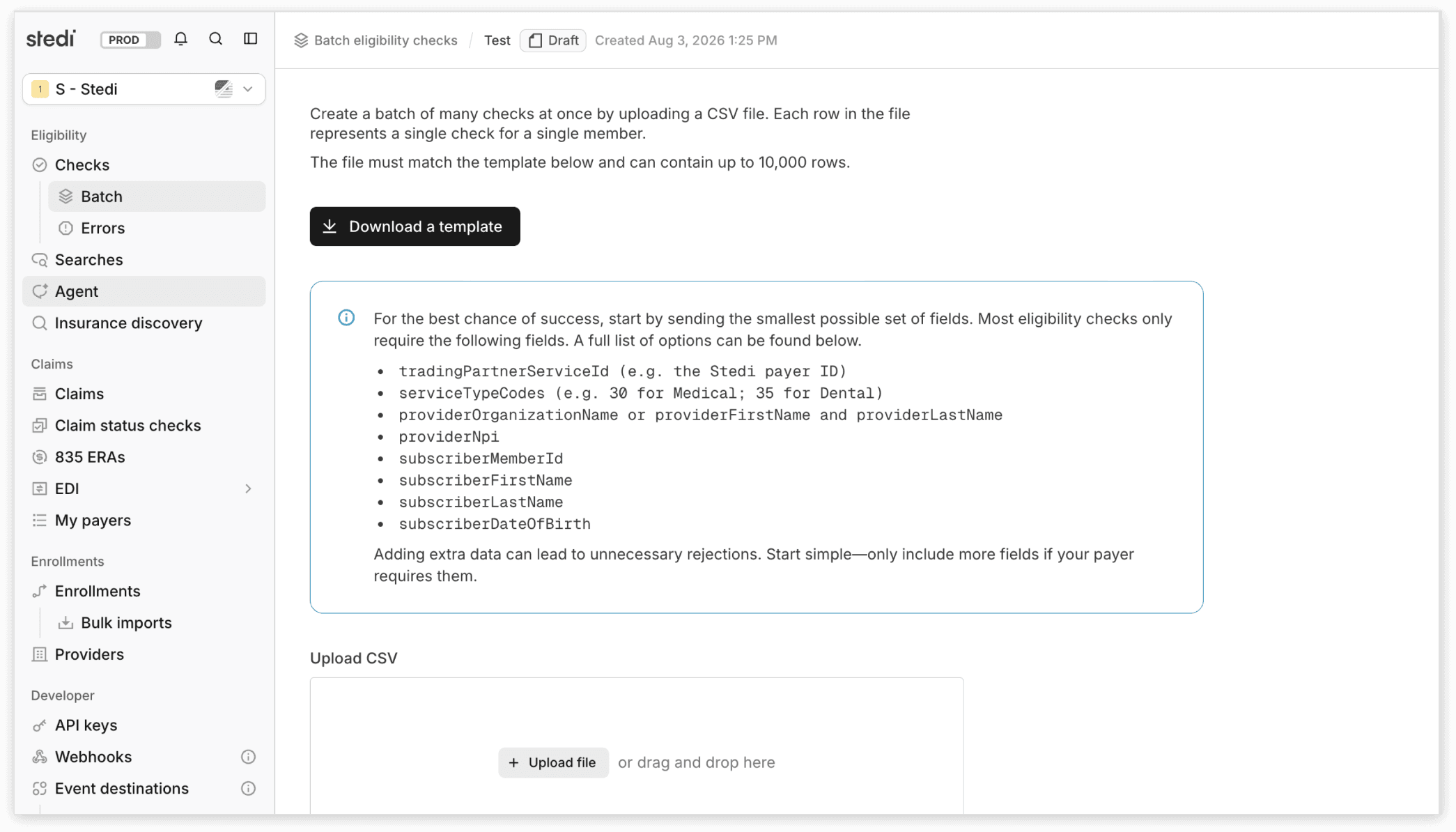
Batch checks are built for big jobs that can wait minutes or hours. If a check fails because a payer was down, Stedi retries it automatically. You can set the retry window from 8 to 24 hours.
Batch checks run in their own lane, so a background refresh never slows down the checks your staff run live.
4. Catch claim errors before the payer sees them
A claim that's rejected by the payer is slow twice. First, the payer's rejection can take days to arrive. Then someone has to fix the claim and resubmit it, and the wait starts over. If you don't resubmit by the payer's filing deadline, the claim may never get paid at all.
Every claim you submit through Stedi runs through a series of validation checks – called claim edits – that mirror the checks payers perform. We build them by studying real rejections across our payer network, starting with the most common and most expensive.
Stedi uses repairs to fix some problems automatically, like a phone number with hyphens a payer won't accept. You don't need to do anything. For the rest, you get a plain-language error as soon as you submit. It tells you what's wrong and how to fix it. That lets you or the provider correct the claim and resubmit faster.
The goal is for the payer to accept the claim. Claims submitted through Stedi have a 98% payer acceptance rate.
You can submit claims using Stedi's Claims APIs or SFTP. You can also submit professional claims in the Stedi portal.

To learn more, see How we build our claim edits database.
5. Let Stedi handle transaction enrollment
Revenue recovery and reconciliation start with one question: Did the claim get paid? The payer's answer usually arrives as remittance, a report of what the payer paid and why.
Many payers can send remittance electronically, as Electronic Remittance Advice (ERAs), to the healthcare clearinghouse on file with the payer. ERAs make it easier to post and reconcile a provider's payments, so setting them up is often a priority for BPOs.
To set or change the clearinghouse where a provider receives ERAs, the provider has to complete a process called transaction enrollment with the payer.
Every payer requires transaction enrollment for ERAs. Some payers require enrollment for other transaction types too, like eligibility checks.
The exact steps required for transaction enrollment vary by payer. Multiply those differences by every payer the provider bills, then by every provider in your book. That variety can make transaction enrollment difficult and expensive to run at scale.
That's why Stedi offers fully managed transaction enrollment. We do the work for you.
You submit the payer, the transaction type, and the provider's details – name, NPI, tax ID, contact information – in the Stedi portal or through our Enrollments API.
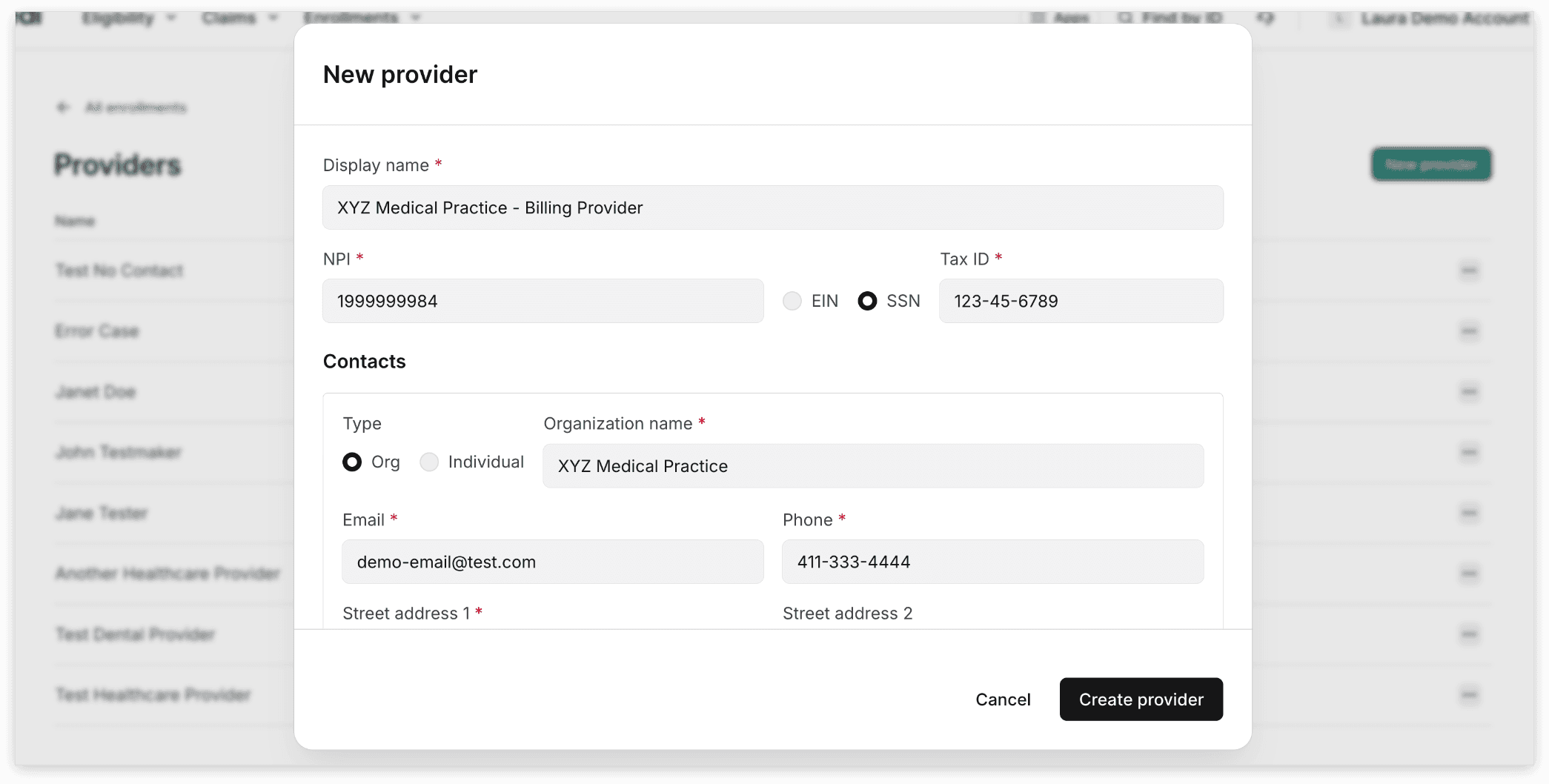
For the 1,500+ payers that support one-click enrollment for ERAs, submitting the request is all you do. Stedi does the rest.
For payers that require additional steps, Stedi provides clear next steps. And you can track the status of all your transaction enrollment requests in the Stedi portal or through the API.
6. Build your own RCM tools
If your company has access to a developer, they can build custom tools for your team on Stedi's APIs and MCP server, a connector that lets AI tools work with Stedi's Eligibility and Payers APIs directly.
Stedi also works well with AI coding agents, like Claude Code and Codex. Point the agent at Stedi's plain-text docs and OpenAPI specs, and it can build working tools fast. For an example, see our Build an insurance verification app in 30 minutes blog post.
The agent can use Stedi's mock eligibility check workflow and test claims workflow to test the integration end to end without using real patient data or sending transactions to real payers.
For more tips, see How to use Stedi with a coding agent.
Get started with Stedi
To get started with Stedi, sign up for a free sandbox account. It takes less than two minutes. No credit card is required.
Sandbox accounts include the Stedi portal, so you can see where your team would work. When you're ready, upgrade to production on our pay-as-you-go plan. There are no monthly minimums or setup fees. You only pay for the transactions you use.